
The game begins with a simple bargain: play the course as you find it, play the ball as it lies, and call the penalty even when nobody else saw it.
The Rules of Golf are a carefully constructed system designed to answer almost every question the game can produce. Rule 1 is short. It answers the question underneath all the others:
What kind of player are you when nobody is watching?
Brian Davis is standing in dying cordgrass at the edge of Calibogue Sound, where the air smells like low tide and bad decisions. It is the first playoff hole of the 2010 Heritage at Harbour Town. Jim Furyk has already taken the sensible route and laid up. Davis is still searching for his first PGA Tour victory, and the green sits on the other side of one heroic swing.
He pulls a fairway wood.
The shot does not quite find the water and does not quite escape it. The ball clings to the bank among loose reeds. Davis wades in, takes his stance and starts the club back. Somewhere in the motion, he senses the faintest contact.
Not a chop. Not an obvious disturbance. A whisper.
The television replay will later need slow motion to establish what happened. In real time, Davis is the only person certain enough to stop.
He steps back, calls over rules official Slugger White and tells him he believes his club touched a loose reed during the backswing. The penalty is two strokes. Furyk wins. Davis loses the playoff and the best chance he ever had at a PGA Tour title.
That moment is Rule 1 compressed into a few marsh-soaked seconds. Davis is the witness, the prosecutor and the judge. The game does not catch him. He reports himself.
That is the bargain.
“He is the witness, the prosecutor and the judge — all at once, all alone, in the time it takes a reed to stop moving.”
The Constitution Hiding on Page One
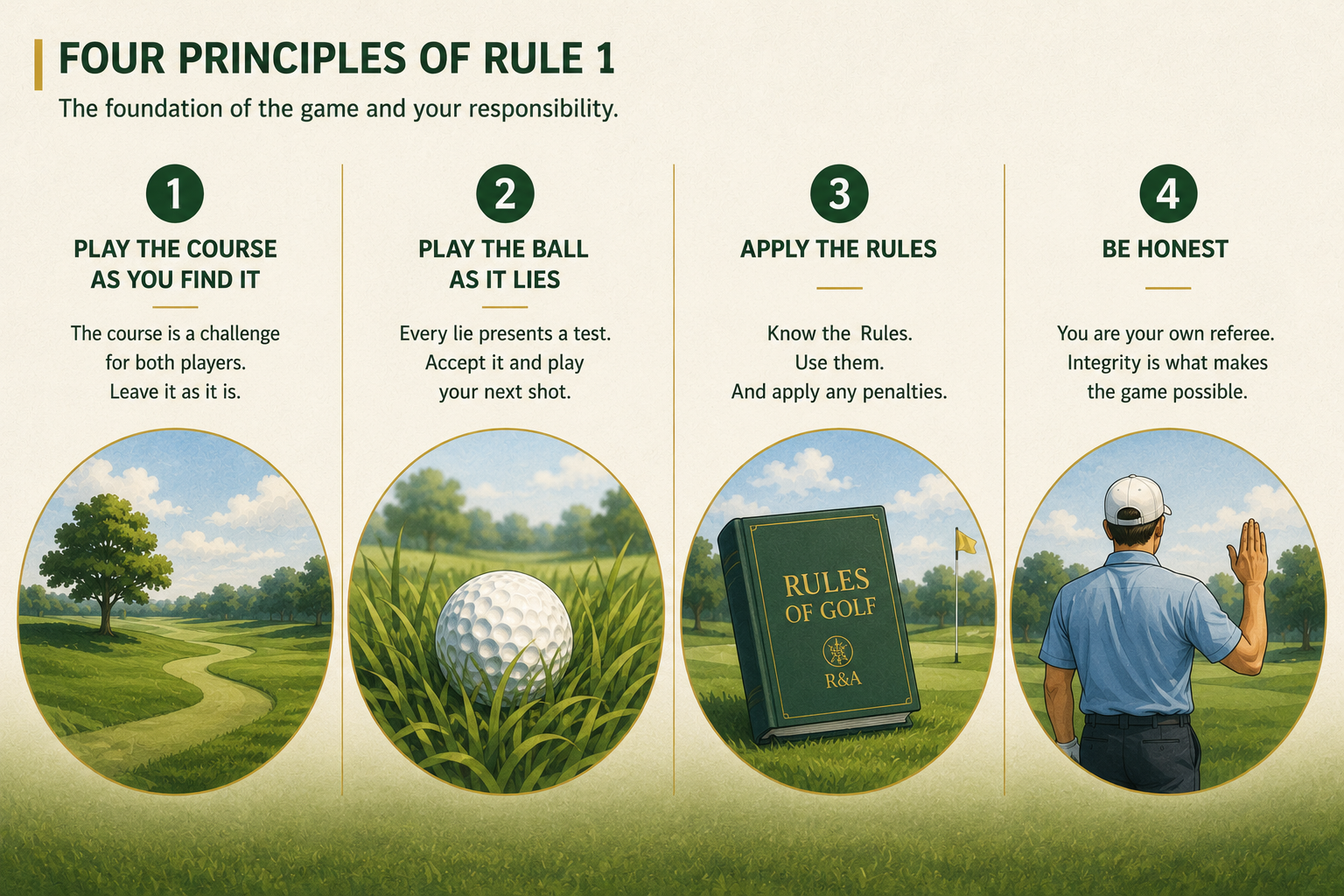
The official purpose of Rule 1 is built around three principles:
- Play the course as you find it and play the ball as it lies.
- Play by the Rules and in the spirit of the game.
- Apply your own penalties when you breach a Rule so you cannot gain an advantage.
Those principles are not every procedure in the Rules of Golf. Rule 1 establishes the responsibility; the other Rules define the individual breaches, penalties and relief procedures.
RULE 1 AT A GLANCE
Rule 8 explains when a player has improved the conditions affecting a stroke. Rule 9 deals with a ball at rest that has moved. Rule 12 governs bunkers. Rule 18 covers stroke-and-distance relief for a lost ball or a ball out of bounds. Rule 3 addresses competition and scorecards.
Rule 1 sits above all of them and says: you are responsible for applying them honestly.
That is why it feels less like an ordinary rule and more like a constitution. The rest of the book tells you what to do. Rule 1 tells you who must do it.
Golf is unusual because enforcement is not external to the player. There is no official accompanying every group and no replay booth reviewing every lie. The game places the burden on the person who stands to benefit from silence.
In basketball, an uncalled foul disappears into the next possession. In football, an unseen hold becomes part of the result. In golf, an unseen breach remains the player’s responsibility.
The Rules do not say, “We will catch you.”
They say, “We trust you.”
“The penalty is not only the stroke added to the card. It is the version of the round you must live with afterward.”
Three Golfers Rule 1 Eventually Finds
Rule 1 does not land the same way on everyone. It finds players in proportion to where they are in the game — and sometimes where they are in life.
The Compliant Golfer
The compliant golfer follows the Rules almost instinctively. A silent breach would bother them more than a double bogey. They are not performing integrity for an audience; they simply cannot enjoy a score they do not believe.
Brian Davis belongs here. Sahith Theegala offered another modern example at the 2024 Tour Championship when he reported that his club had touched sand during a backswing from a fairway bunker. The contact was slight. The penalty was not.
The Convenient Golfer
The convenient golfer follows the Rules until the Rules become inconvenient. Their vocabulary is sophisticated:
- “We are just out here for fun.”
- “Everyone takes that drop.”
- “That was basically in the fairway.”
- “We are not going back to the tee.”
Casual groups are free to choose their own form of play. The problem begins when an informal round is later presented as something it was not — a competition score, an official handicap score or proof of a personal best under the Rules.
The issue is not that every Saturday round must become a courtroom. It is that the story attached to the number should be honest.
The Conflicted Golfer
The conflicted golfer knows the Rules, intends to follow them and still hears a negotiation begin when the ball settles against a root with nobody nearby.
This is the most human category and probably the largest.
Rule 1 was written for every player, but it is most alive in the conflicted golfer — the person who knows what should happen and is deciding whether convenience will be allowed to rename it.
The Unfair, Beautiful Contract
Most sports assume that players will test the edge of enforcement. Golf assumes something more radical: the player will protect the field even when doing so harms their own score.
That creates an extraordinary contract.
When you mark a ball, record a score or take relief, you are not merely completing a procedure. You are participating in an experiment in trust. The game assumes you will accept a bad lie without inventing compensation. It assumes you will add a penalty that nobody demanded. It assumes you will distinguish between what happened and what you wish had happened.
This is the beauty and the cruelty of “play the course as you find it.”
A ball in an old divot is not moral injustice. A branch in the backswing is not evidence that the course owes you a better outcome. The Rules provide relief in specific circumstances, not whenever fairness feels emotionally persuasive.
Golf does not promise perfect lies. It promises that the same framework applies to everyone.
That is why a completely honest 79 can feel more satisfying than a 74 assembled through three quiet negotiations. One number is lower. The other is yours.
“A 74 that includes three silent bargains is just a number. A 79 played honestly is a story you can live with.”
From Reputation to Rule 1
The earliest written rules of golf, produced at Leith in 1744, focused on how the game was played: order of play, bad lies, hazards and lost balls. They emerged from a culture in which reputation carried enormous weight.
For generations, the honour system existed partly because golf communities were small. A player who became known for moving a ball or miscounting strokes did not need a formal suspension to feel the consequence. Invitations disappeared. Trust travelled faster than any written ruling.
Then golf changed.
The game became richer, more televised and more exposed to slow-motion evidence. Millions of viewers could inspect a movement that nobody on the course noticed. The boundary between personal responsibility and technological surveillance became increasingly uncomfortable.
Lexi Thompson’s 2017 ANA Inspiration became the defining example. A television viewer alerted officials to an incorrect ball replacement from the previous round. Thompson was assessed four strokes under the Rules then in force — two for the placement and two for the incorrect scorecard — and eventually lost the championship in a playoff.
The controversy accelerated changes in how video evidence and outside information were handled. Modern Rules use a naked-eye standard and formal review protocols intended to prevent microscopic video analysis from replacing what could reasonably have been seen on the course.
The 2019 modernization did not invent golf’s honour system. It made its governing principles more explicit. Player conduct moved directly into Rule 1, committees were given clearer authority to adopt Codes of Conduct, and serious misconduct could justify disqualification.
Sergio Garcia’s disqualification from the 2019 Saudi International after intentionally damaging putting greens became an immediate illustration. Rule 1 was not merely about a ball and a score anymore. It formally stated that conduct can become so far removed from the spirit of the game that the player no longer belongs in the competition.
What Rule 1 Requires From You
Rule 1 is short, but its responsibility appears everywhere.
Play the Course as You Find It
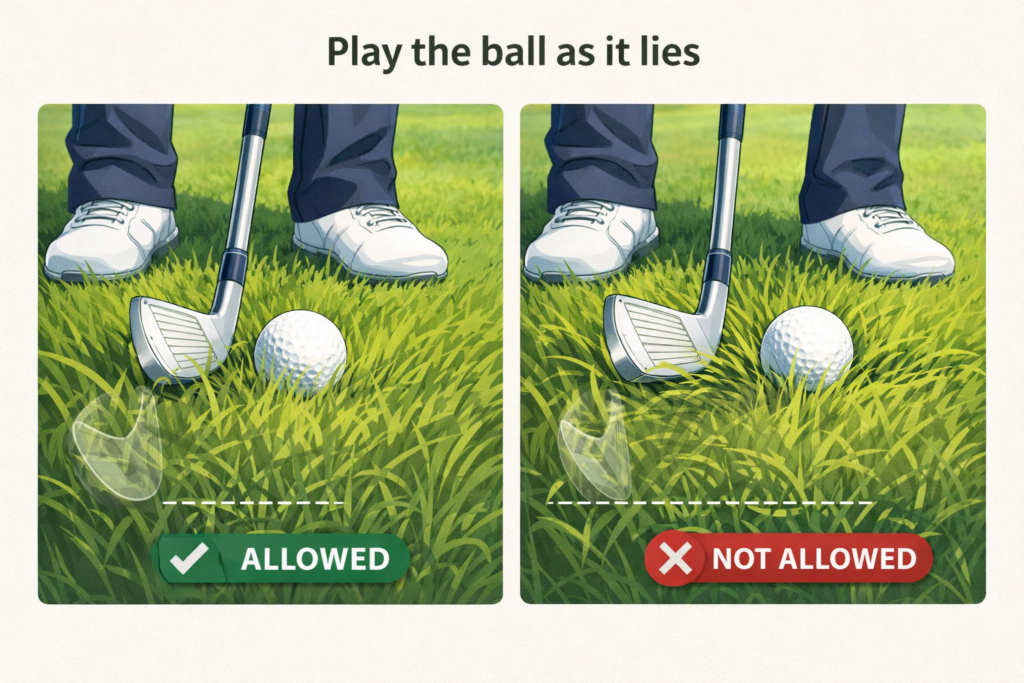
You may not improve the conditions affecting your stroke unless a Rule allows it. The detailed restrictions live in Rule 8, but the principle begins here.
Common examples include:
- Pressing down grass to create a better stance.
- Breaking or bending a growing branch that interferes with the swing.
- Moving, bending or breaking something fixed to improve the line of play.
- Deliberately altering the surface around the ball.
The Rules do allow many ordinary actions: fairly taking a stance, grounding the club in permitted areas, removing loose impediments and taking authorized relief. The point is not that the player must avoid touching the course. The point is that the player cannot manufacture an advantage outside the permissions of the Rules.
SEE IT IN ACTION

Play the Ball as It Lies
Rule 9 develops this principle in detail. If the ball moves, the first question is not whether the new position is better or worse. It is why the ball moved and what the Rules require next.
A ball that merely oscillates and returns to its original spot has not moved. A ball that leaves its spot and comes to rest elsewhere has moved.
Natural forces may move a ball without penalty in many situations. A player who causes the ball to move may need to replace it and take a penalty, depending on the circumstances and the applicable Rule.
The obligation is to establish the facts honestly, not to begin with the preferred outcome.
SEE IT IN ACTION
Apply Your Own Penalties
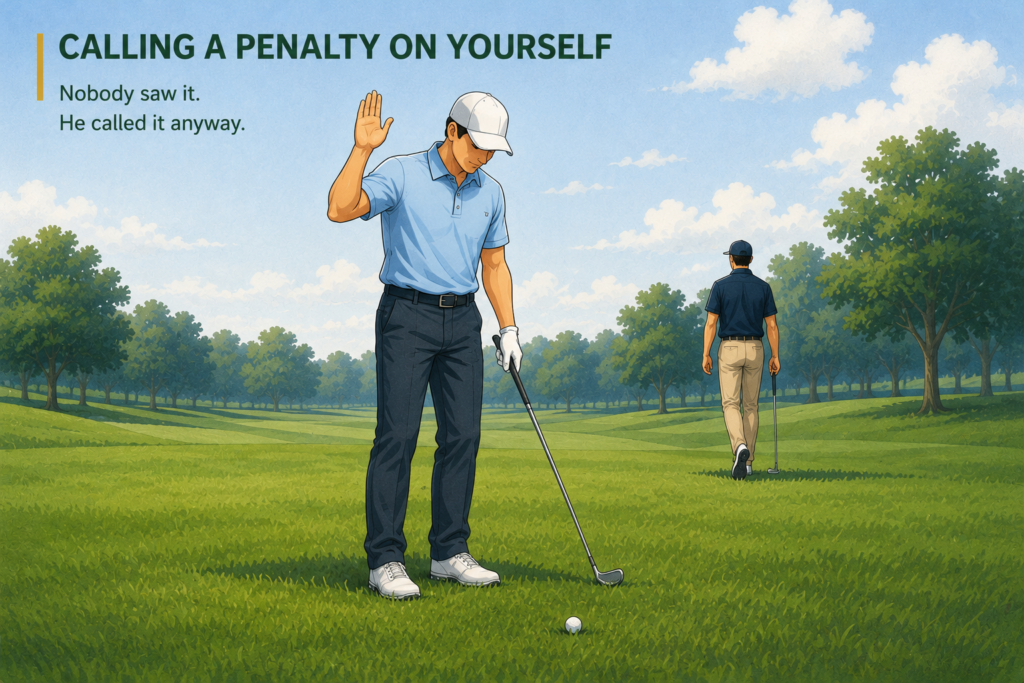
This is the heart of Rule 1.3.
If you know you breached a Rule, the fact that nobody else saw it does not erase the breach. If you are unsure, you are expected to resolve the uncertainty using the procedures available: ask another player, consult a referee or committee, or use the appropriate process under Rule 20.
Ignorance does not automatically remove a penalty, but the Rules do distinguish between different forms of error. For example, returning a hole score lower than actually made will normally result in disqualification, but there is a limited exception when penalty strokes were omitted because the player did not know about them before returning the scorecard.
Rules precision matters. So does honesty about what you knew and when you knew it.
Play in the Spirit of the Game
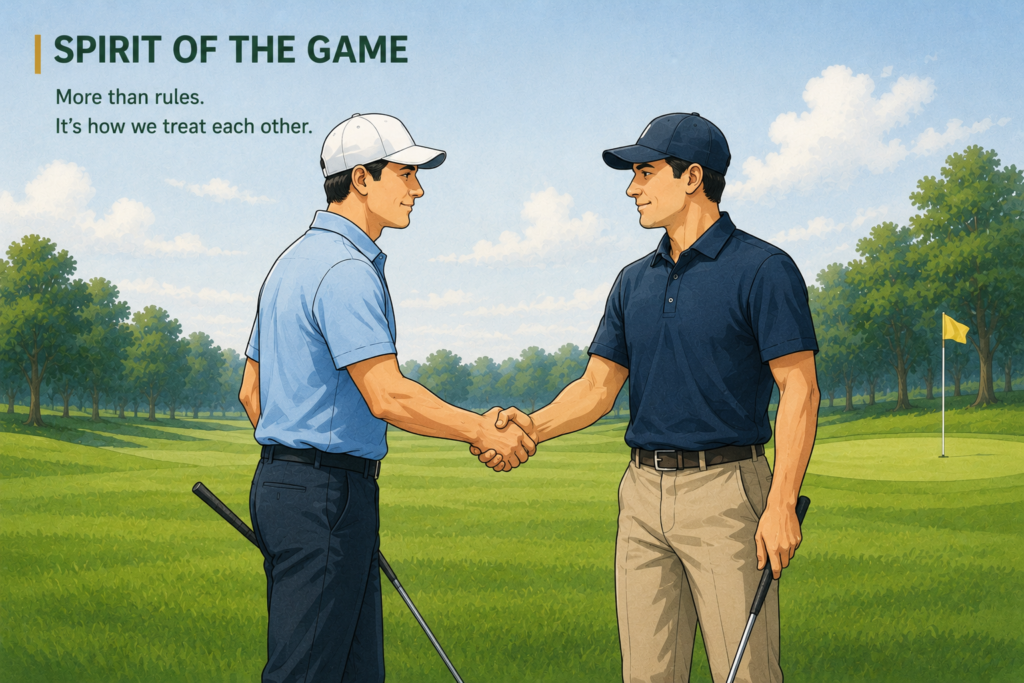
Rule 1.2 expects integrity, consideration for others and care of the course.
Most discourteous behaviour does not automatically produce a penalty under the Rules, although a committee may adopt a Code of Conduct with specific sanctions. Serious misconduct is different. Conduct so far removed from what golf expects that removal from the competition is justified can lead to disqualification.
Deliberately causing serious damage to a putting green is an established example. Threatening another person or deliberately distracting a player during a stroke may also qualify, depending on the circumstances.
The committee considers the act, its severity and its context. “Serious misconduct” is not a label attached to every flash of frustration. It is the game’s most severe response to conduct that breaks the social contract.
The Cruelty of Proportional Temptation
Rule 1 may be hardest on the golfers who need mercy most.
A scratch player encounters plenty of difficult decisions, but many of their shots begin from fairways and manageable lies. The 25-handicapper is playing a different game. Every round becomes extreme gardening in uncomfortable shoes. The worse the ball-striking, the more often the player visits trees, fescue, roots and places where taking a stance can become an ethical negotiation.
The standard does not become easier because the player is struggling.
I once watched a good man — an accountant, a father, someone you would trust with almost anything — stand in knee-high grass and perform what could only be described as an interpretive dance with his feet. By the time he had finished “getting comfortable,” the lie looked maintained.
He hit an eight-iron to ten feet and called the result par.
He was not a villain. He was a tired golfer who had found deep rough nine times and run out of virtue around the 11th hole.
Most players recognize some version of that moment.
Rule 1 is not powerful because it proves golfers are naturally noble. It is powerful because it asks for honesty precisely when honesty is inconvenient.
Rule 1 in the Wild
Professional golf gives us famous cases because cameras preserve them. The principle is the same on an empty municipal course.
Brian Davis: The One Who Called It
Davis’s penalty at Harbour Town remains one of the clearest examples of self-enforcement. He believed he had touched a loose reed during the backswing. The contact was difficult to see, the cost was enormous and the call came from him.
The moment survives because he protected the competition at his own expense.
Sahith Theegala: The Contact Nobody Needed to Notice
At the 2024 Tour Championship, Theegala reported that his club had touched sand during the backswing from a fairway bunker. The slight contact resulted in the general penalty in stroke play.
The lesson was not that every ambiguous sensation must become punishment. It was that once Theegala believed a breach had occurred, the absence of an external witness was irrelevant.
Patrick Reed: The Burden of Appearance
At the 2019 Hero World Challenge, television footage showed Reed moving sand behind his ball during practice swings in a waste area. He received a two-stroke penalty.
Reed maintained that camera angles affected how the incident appeared. The episode became a reminder that Rule 1 is not only about what a player says happened; elite golf also operates inside public evidence and public trust.
Reputation is not a substitute for a ruling. But once trust is damaged, every future ambiguity becomes harder to survive.
Lexi Thompson: When the System Became the Story
Thompson’s penalty at the 2017 ANA Inspiration exposed a different problem: the game’s honour system had become intertwined with outside surveillance.
The breach was real under the Rules then in effect. The delayed intervention and added scorecard penalty were also so severe that they changed the tournament. The response helped produce a more balanced modern approach to video evidence.
Rule 1 asks players to referee themselves. It should not require them to defeat microscopic evidence that no human could reasonably have detected at the time.
Common Rule 1 Moments
These are not all breaches of Rule 1 itself. They are situations in which Rule 1’s responsibility requires the player to identify and apply another Rule correctly.
You Think the Ball Moved at Address
First determine whether it actually left its original spot and came to rest elsewhere. If it only oscillated and returned, it did not move.
If it moved, determine the cause. Natural forces and player-caused movement are treated differently. Do not guess from the result; establish the facts.
You Accidentally Kick the Ball While Searching
There is generally no penalty for accidentally moving the ball while trying to find or identify it. Replace the ball on its estimated original spot.
The protection exists for a genuine search. It does not authorize improving the lie or testing the grass once the ball has been found.
Your Club Touches Sand During a Practice Swing in a Bunker
Touching sand with the club during a practice swing normally brings the general penalty: loss of hole in match play or two strokes in stroke play.
The Rules also contain permissions for touching sand in other circumstances, so the context matters. “The club touched sand” is not the end of every analysis; what the player was doing matters.
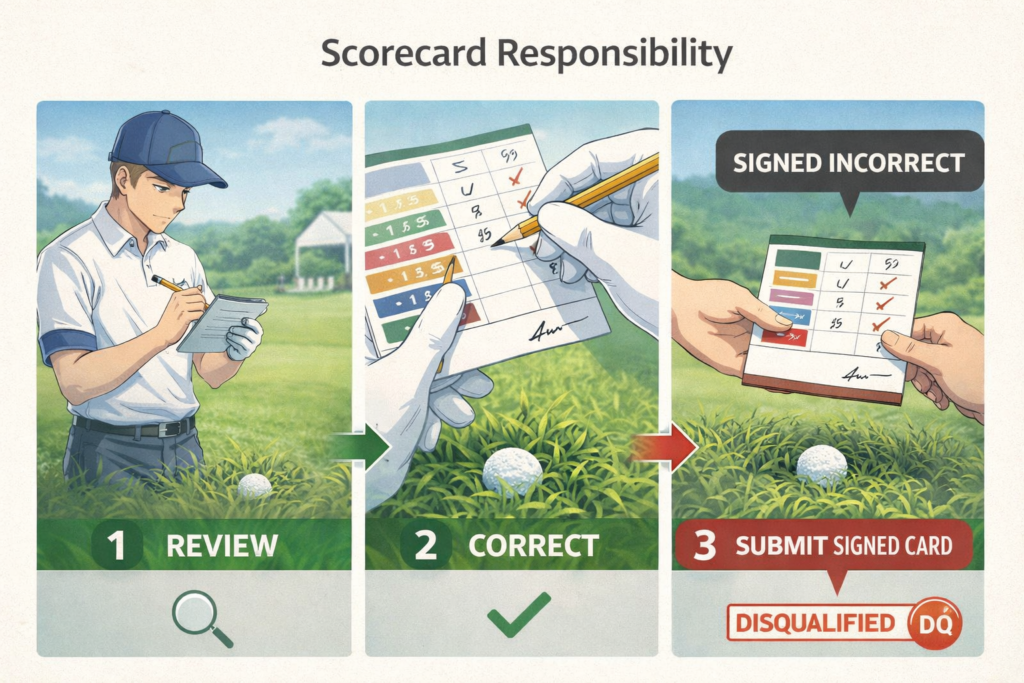
You Remember a Penalty Before Returning the Scorecard
Stop and resolve it. Correct the score, tell the committee and include the penalty before returning the card.
You Remember It After Returning the Scorecard
The outcome depends on the facts, including whether you knew about the penalty when the card was returned. Do not assume either automatic forgiveness or automatic disqualification. Report it to the committee immediately.
SEE IT IN ACTION
Your Group Agrees to Ignore a Rule
Players may choose an informal game, but they cannot knowingly agree to ignore a Rule or penalty in a competition. For handicap purposes, authorized Local Rules and acceptable-score procedures matter; a casual agreement invented on the first tee is not automatically equivalent to an authorized Local Rule.
What to Do When You Think You May Have Breached a Rule
Stop Before the Next Stroke
Do not rush because the group behind is waiting. A preventable second error is rarely faster.
Establish the Facts
Did the ball move? Did the lie improve? What did the club touch? What did you know, and when?
Ask for Help
Invite another player, referee or committee member into the process when one is available.
Identify the Applicable Rule
Rule 1 establishes your responsibility, but the procedure may be found in Rule 3, 8, 9, 12, 18, 19 or another Rule.
Correct the Situation When Allowed
Replace the ball, take the required relief or apply the correct penalty before continuing.
Record and Report It
Add the penalty immediately and resolve any remaining uncertainty before returning the scorecard.
There is no shame in needing help with a ruling. The problem is not uncertainty. The problem is allowing uncertainty to become permission.
The Freedom on the Other Side of Honesty
There is no clever strategy that defeats Rule 1. But there is a way to make it easier to carry.
Decide in advance what kind of score you want.
If you want an official score, play under the Rules and use the relief procedures they provide. If you want a relaxed social game, agree on the format before the round and describe the result honestly afterward.
Invite your group into ambiguous moments. Transparency spreads the weight of the decision and protects everyone from the suspicion that arrives later.
Most importantly, record penalties when they happen. A penalty written down immediately becomes part of the round. A penalty postponed becomes a negotiation.
The golfers who commit to this often become freer, not more constrained. Bad bounces still frustrate them. Difficult lies still feel unfair. But the mental static disappears.
They may be angry at the course.
They are no longer angry at themselves.
The Stories That Live Forever
Strip away the procedures and Rule 1 comes down to one proposition:
Golf hands you the referee’s whistle and says, “We trust you with this.”
It trusts you to admit when something moved. It trusts you to distinguish a legal relief procedure from a convenient invention. It trusts you to protect the field when silence would be profitable.
Brian Davis lost a playoff.
Sahith Theegala added a penalty nobody else demanded.
Lexi Thompson lost a major in an episode that forced the game to reconsider how evidence should be used.
And every Saturday, somewhere, a player stands alone in rough with a ball against a root and a choice nobody else will ever know about.
That private choice is where Rule 1 actually lives.
The grand examples matter because cameras preserve them. The small examples matter because they reveal whether the honour system exists anywhere beyond the stories golf tells about itself.
Brian Davis said what he believed had happened. The words cost him the tournament that day. They gave him something the scorecard does not have a column for.
Be that player.
Call it on yourself. Ask when you are unsure. Take the relief the Rules provide. Accept the lie they do not rescue you from.
Then swing anyway.
FAQ
Does Rule 1 apply only in competition?
Rule 1 states the central principles of the game whenever golf is played under the Rules. A social group may choose an informal format, but it should distinguish that format from an official competition or an acceptable score for handicap purposes. Authorized Local Rules may modify procedures without abandoning the Rules; an improvised agreement to ignore penalties is different.
What counts as serious misconduct under Rule 1.2?
Serious misconduct is behaviour so far removed from golf’s expected standards that disqualification is justified. Official examples include deliberately causing serious damage to a putting green. Threatening another person or deliberately distracting a player during a stroke may also qualify. The committee considers the act, severity and surrounding circumstances.
Can a television viewer still trigger a rules review?
Outside information may alert officials to an incident, but modern review protocols limit how video evidence is used. The naked-eye standard is intended to prevent penalties based on details that could not reasonably have been seen at the time.
What happens if I apply a Rule incorrectly by genuine mistake?
The result depends on the specific Rule, the form of play, when the mistake is discovered and whether it can still be corrected. Ignorance does not automatically remove a penalty. When uncertain, stop, establish the facts and consult a referee or committee before continuing or returning the scorecard.
If my ball moves at address, is there always a penalty?
No. First determine whether the ball actually moved, meaning it left its original spot and came to rest elsewhere. Then determine what caused the movement. Natural forces and player-caused movement are treated differently under Rule 9.
Is touching sand in a bunker always a penalty?
No. The Rules permit touching sand in several ordinary circumstances, but touching it with the club during a practice swing or in testing the condition of the sand is normally prohibited. A breach brings the general penalty: loss of hole in match play or two strokes in stroke play.