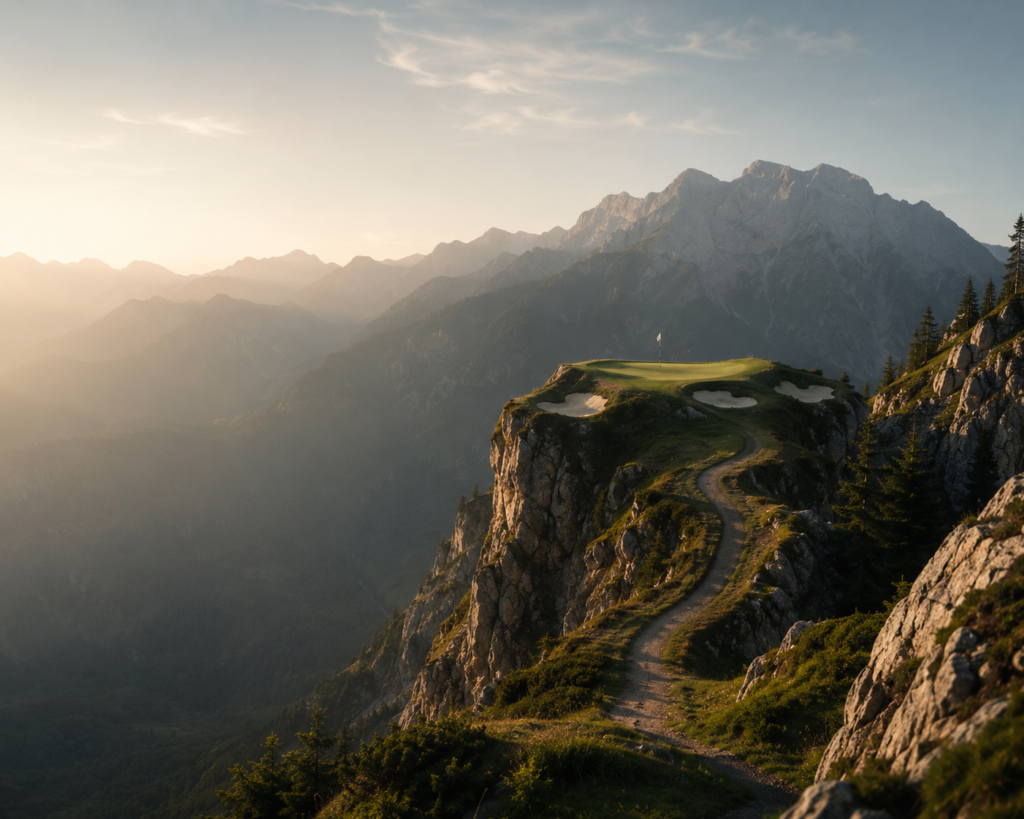
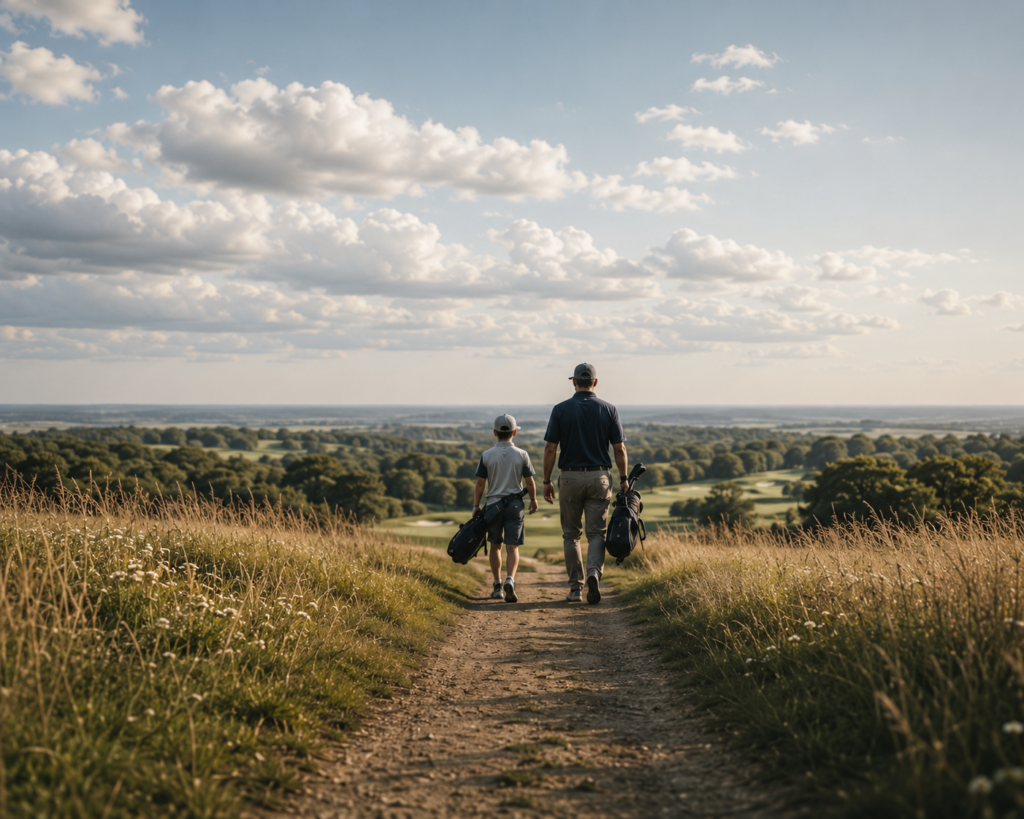
The dirt road ran a long time through dense forest before it let go of the trees all at once and set the course down in front of us like it had been waiting there the whole drive. “We’re going to go hit some balls,” my father said, the way other dads might announce a trip to the hardware store — no ceremony in it, none needed. I remember thinking the trees themselves were bigger here, older, standing straighter than the scrubby windbreak pines around the nine-hole course I usually played with my friends, and I remember thinking the same thing, quietly, about him. He seemed larger on that mountain. Broader in the shoulders, longer in the stride, like the place had been built to a scale that finally matched him.
The lake sat below the first tee, flat and cold and so blue it looked poured rather than filled, and the fairways ran out from it in every direction like the mountain had been arranged around them instead of the other way around. Pines stood sentry down both sides of every hole, dark green shading into a green so pale and new it looked lit from underneath, and somewhere past all of it the peaks just kept climbing until they ran out of things to say. I didn’t have language yet for what a place like that does to a person. I only knew I felt smaller and better at the same time, the particular arithmetic of standing somewhere beautiful enough to remind you how briefly you get to stand anywhere at all.
My father hit first. He always hit first. It was never discussed, never explained — it was simply the order the world moved in when he was part of it, and I stood back and waited my turn without complaint, the way you wait in the presence of something that was there before you and would be there after. I loved my father the way I was already learning, without the words for it yet, to love that mountain and that lake and those trees older than anyone’s grandfather — with a respect that had reverence built into its foundation, the specific awe of standing next to something too large to fully take in at once. He wasn’t unkind. He wasn’t distant, exactly. He simply carried himself like the terrain did — solid, unhurried, unconcerned with whether I found him impressive, which of course made him more impressive than anything that had ever tried.
He handed me a 7-iron he’d cut down and re-gripped himself, the tape still a little rough under my fingers, still smelling faintly of the workbench it had been built on the night before. He didn’t say anything else. He just stepped back, folded his arms, and waited — the way he waited for report cards, for the results of anything, with a face that gave away nothing until it had something worth giving.
The ball went up. Actually up — not just forward, the way a ball goes up when a kid catches one clean by accident and physics decides, just this once, to be generous. It hung there against a sky so wide and so unfinished-looking above that lake that it seemed like the mountain itself was holding its breath, and then it came down soft in the fairway grass, further out than anything I’d hit before, further out than I had any right to expect.
My father didn’t clap. He didn’t say nice shot. He stood there with his arms still folded, watching the spot where the ball had settled, and something moved across his face that I would spend the next thirty years trying to properly name. It wasn’t pride, exactly — pride is loud, even when it’s quiet, and this man didn’t have a loud setting. This was something underneath pride. This was a quiet man, a man who led because leading was the only language he fully trusted, standing next to his son and, for about four seconds, having nothing left to lead. Just watching. Just there.
FIELD NOTES
I’ve hit something north of forty thousand golf balls since that afternoon on that mountain. Better clubs, better courses, better swings by every technical measure — and not one of them has made a golf ball feel the way that one felt, hanging against that impossible sky, my father silent and unguarded beside me for the only four seconds of my childhood I can remember him being unguarded at all.
That’s the first time I understood joy doesn’t announce itself. It just goes quiet, waits for you to notice you’re already standing inside it — and sometimes it borrows someone else’s face to show you it’s real.
Here’s the strange part, the part that took me decades to notice: that afternoon on the mountain is the only time in my whole childhood I remember joy needing a witness. Every other version of it I can find, if I go looking, happened when nobody was watching at all — which raises a question I’ve never been able to fully answer. Does joy require an audience the first time, just once, so you learn what it looks like on a human face before you’re trusted to recognize it in yourself? Or is it the opposite — does joy only ever really belong to you once there’s no one left to perform it for, no father folding his arms, no report card being silently graded, just you and a golf course and whatever the morning is willing to give you?
I’ve come to think it’s both, and that they happen in order. First someone shows you the shape of the thing. Then, if you’re lucky, you spend the rest of your life finding it again on your own — smaller, unwitnessed, and somehow more yours for it. There’s a version of joy that only shows up when you’re completely alone, when there’s no one around to confirm you felt what you think you felt. I didn’t understand that version yet at seven years old on that mountain, standing next to a man whose approval I was still years from learning I didn’t need in order to feel it.
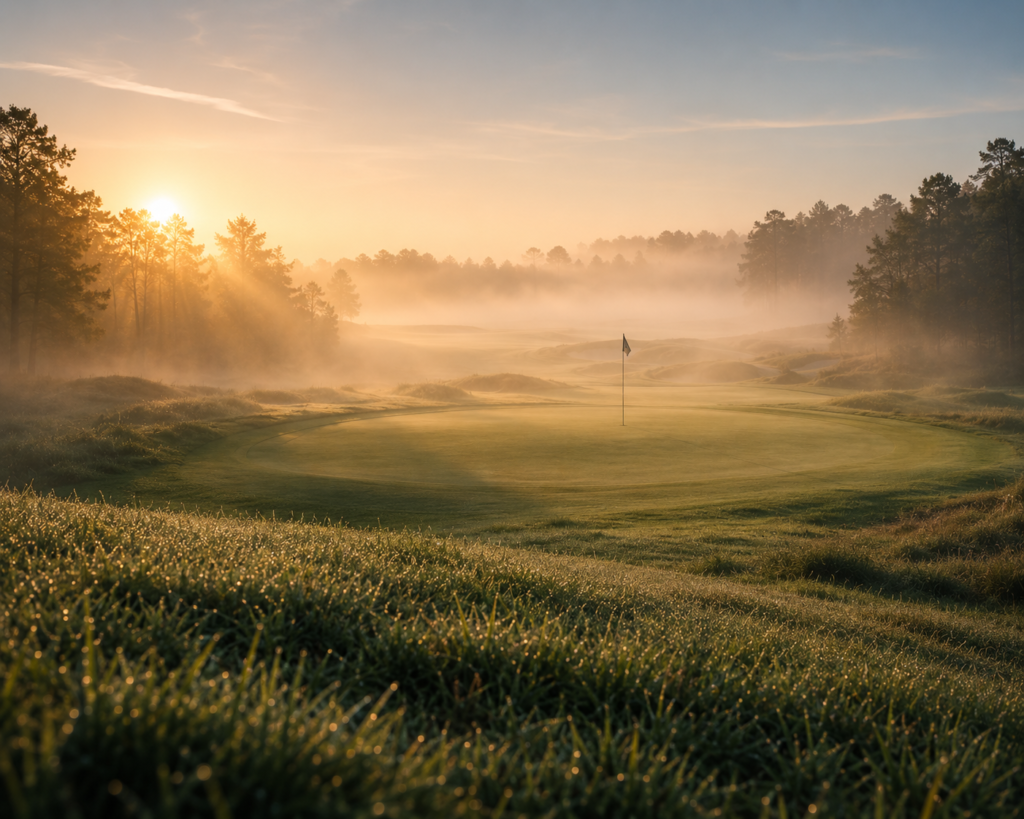
I understand it now. It looks like six in the morning, and a golf course with no one on it yet, and dew still holding onto grass that hasn’t decided yet what kind of day it’s going to be.
The starter doesn’t ask why you’re there alone at 5:40 in the morning. He just writes your name on the sheet, hands you a scorecard you already know you won’t fill in completely, and tells you the frost delay lifted twenty minutes ago, which is his way of saying: go. There’s no one behind me on the tee sheet. No one in front of me either, as far as I can tell. For the next two hours, the golf course and I have an arrangement, and neither of us is going to mention it to anyone else.
The first fairway is still more silver than green. Dew sits on every blade of grass in a way it won’t by seven, in a way it can’t survive the sun, and there’s something in knowing that — that this particular version of the course has maybe forty minutes left to live — that makes every step across it feel slightly stolen. My shoes are wet through by the third hole. I don’t mind. I’ve stopped minding things like that at this hour, the way you stop minding a lot of things once there’s no one around to notice whether you mind them or not.
There’s a specific temperature to this kind of morning, too — cool enough that your breath shows for the first two holes and then doesn’t, the day warming up around you so gradually you never catch the exact moment it happened. The air smells like cut grass and last night’s rain and, faintly, like nothing at all, the particular blankness of a world that hasn’t been driven through or talked over or filled up with other people’s plans yet. I’ve come to love that blankness the way some people love a blank page. It isn’t empty. It’s just unclaimed, for now, and I happen to be the one standing in it.
There is a specific sound to being the only person on a golf course, and it isn’t silence. It’s smaller than that. It’s the click of a ball being placed on a tee, amplified by having nothing else to compete with. It’s a zipper. It’s your own footsteps on grass so wet they barely make a sound at all, just a soft percussion under everything, proof you’re still moving through the world even when the world hasn’t fully woken up to receive you yet. I’ve played this same front nine with three other guys, laughing the whole way, radios in the carts, and I’ve played it exactly like this — alone, silent, half-formed light coming up sideways through the trees — and I could not honestly tell you which version I love more. I only know they’re not the same game. They just happen to use the same clubs.
Somewhere around the sixth hole the sun finally clears the tree line and everything changes color at once, all the silver going gold in about ninety seconds, like the course had been waiting the whole round to show me what it actually looked like. I stop walking. I don’t hit a shot, don’t check a phone, don’t do anything at all except stand in a fairway by myself and watch a golf course get lit like a stage nobody bought a ticket to but me. And something in my chest just — settles. Not excitement, nothing that needs to move or make a sound. Something closer to a held breath finally being let out, slow, all the way, until there’s nothing left in me but the plain fact of being exactly where I am. I don’t smile so much as stop bothering not to. There’s no one to perform this for, no one to tell afterward, and for once that isn’t lonely. It’s the whole point. This feeling doesn’t need a witness to be real. It just needs somewhere to land, and this morning, it’s landed in me.
Nobody will ever ask me about this round. There’s no scorecard worth keeping, no story worth telling anyone at the clubhouse — what’d you shoot, who were you with — because the honest answer to both is nothing that matters, and nobody, and that’s exactly the point. This is the version of joy that doesn’t need translating into a story afterward, because there’s no one to tell it to and, for once, I don’t need there to be. It only ever needed me.
Here’s what nobody explains about this game when you’re starting out: golf will let you play beautifully for six holes and then take it all back without warning, without mercy, without the decency of an explanation. A drive into a hazard you’ve cleared four hundred times before. A three-putt from a place on the green where three-putting shouldn’t be geometrically possible. The scorecard turns on you the way weather turns on a mountain — fast, total, indifferent to how well you were doing a moment ago. And the strange part isn’t that golf does this. Every difficult thing worth doing turns on you eventually. The strange part is what golf does next, which is not what anything else in my life has ever done in the same circumstance.
A bad quarter at work doesn’t hand you a redemptive email halfway through. A fight with someone you love doesn’t pause itself so you can feel, just for a second, exactly how good things used to be. Most disasters simply run their course, all the way to the end, without interruption, without grace notes, and you’re left to add up the wreckage once it’s finally over. Golf refuses to do that. Somewhere in the middle of a round that’s already gone — a round you’ll shoot ninety-something on, a round with no redeeming scorecard, nothing to defend to anyone at the bar afterward — the game hands you one shot. Just one. Pure, uncomplicated, better than you are. It doesn’t apologize for the eight holes that came before it. It doesn’t explain why now, why this shot, why you, of all the mediocre golfers currently ruining their Saturday across this city. It just happens, mid-disaster, like proof of something you’d started to doubt.
I think golf is the only pursuit I’ve ever found that refuses to let failure be the whole story, even after failure has clearly, mathematically, undeniably won.
I shot a ninety-four on a Tuesday in July, on a course I usually break eighty on, and I could walk you through the whole ugly autopsy of it if you wanted — the two lost balls on the back nine, the three-putt from four feet that still visits me sometimes late at night for no reason at all, the seven I made on a hole I’ve birdied a dozen times. I won’t, though, because none of that is the part I remember. None of that is the part that matters. What I remember is standing in a bunker on fifteen, buried lie, forty feet from a pin cut dangerously close to the water, having already accepted — fully, calmly, without drama — that I was going to make double bogey and move on with my ruined afternoon. And then I didn’t. The ball came out low and soft and perfect, checked once on the green like it had somewhere better to be, and rolled to a stop three feet from the hole. Three feet. On a shot I’d mentally already written off as unsalvageable.
That’s the thing about this game nobody quite prepares you for. It doesn’t reward you on a schedule. It doesn’t wait until you’ve earned it, played well enough, strung together enough good holes to deserve something beautiful. It just gives it to you — sideways, out of nowhere, in the middle of your worst version of yourself.
A 330-yard drive, dead straight, on a hole where straight was the only thing that mattered, hit on a day I’d already three-putted twice and hooked two balls into the trees. A wedge from a hundred and ten yards that I didn’t even watch land because I was too busy watching the flag, and then it wasn’t there anymore, and the flag was doing something the flag doesn’t usually do, and I stood there in the fairway not quite believing my own eyes on a day I’d shot eighty-nine and hadn’t earned a single bit of it. A putt from sixty feet, pure feel, no business going in, that dropped anyway on a green I’d three-jacked twice already that same round. None of these happened on my good days. That’s not a coincidence. I don’t think it’s a coincidence at all.
I’ve had rounds where I shot my career low and can’t recall a single shot from them with any real clarity — just a number, a scorecard, a vague pleasant fog of a day that went the way it was supposed to. But I remember every one of the ones above in complete, embarrassing detail — the exact lie in that bunker, the exact sound the wedge made, the exact color of the sky the day that putt from sixty feet found the hole. That’s the tell. That’s the whole thing right there. The rounds I actually loved weren’t the ones where everything went right. They were the ones where almost nothing did, except the one thing that did it so well it made up for all the rest.
I think that’s the actual architecture of joy in this game, if I’m honest about it — not the smooth rounds, not the ones you’d show someone if you were trying to prove golf was worth playing. The ones that stay with you are the ones where the game had every right to break your heart completely, and instead, for one shot, out of nowhere, undeserved and unearned, it didn’t. Maybe that’s the whole appeal, the thing that keeps bringing me back on the mornings I swear I’m done with this game for good. Golf never promises you a good round. It only ever promises you one good shot, somewhere in there, if you’re still paying attention when it comes.
For a long time I thought that was the whole story — that the truest joy in this game was a private transaction, something that happened between you and a golf course with as few witnesses as possible. The mountain taught me that. The dawn round confirmed it. Even the bunker shot on fifteen was a joy I mostly kept to myself, the kind of thing you mention once at dinner and then let go, because trying to explain it to someone who wasn’t standing there always falls a little flat.
I don’t think that anymore, either. Some of the best joy I’ve ever felt on a golf course wasn’t mine alone at all. It was borrowed, shared, doubled back and forth across a foursome until none of us could remember whose feeling it had started as.
FIELD NOTES
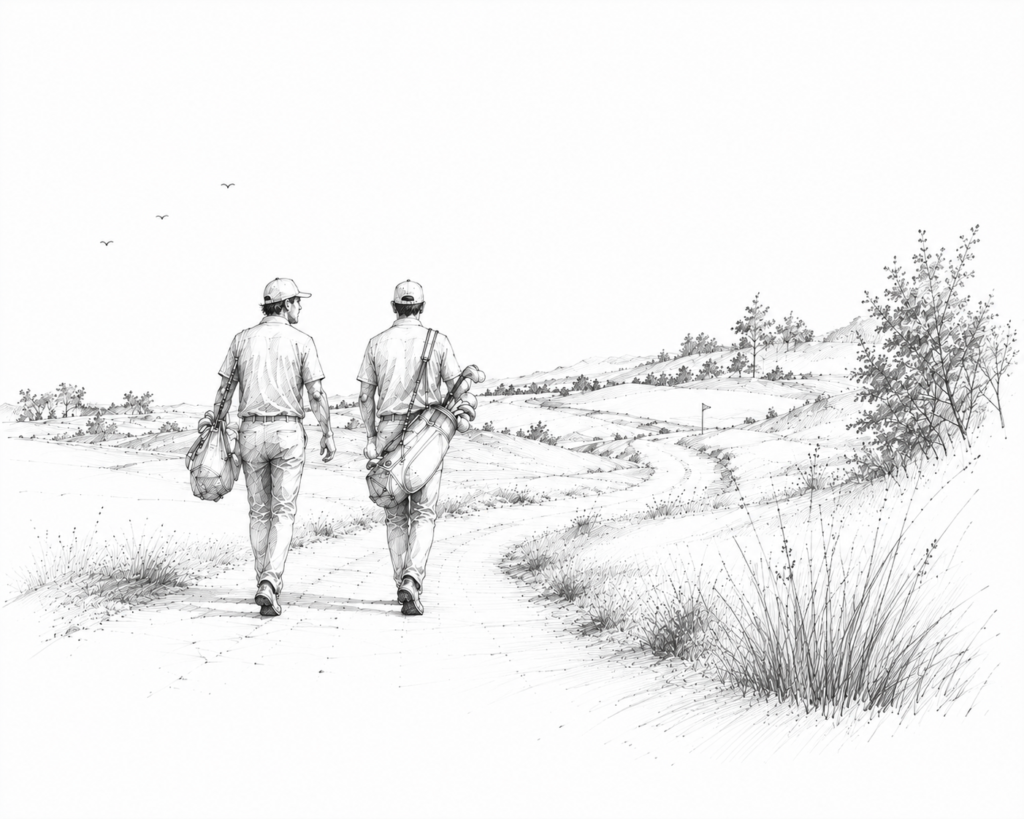
Nobody ever tells you, when you’re seven years old learning this game in near-total silence, that it’s also going to be one of the only places left where you can spend an entire afternoon with the people you love most and never once reach for a phone.
There’s a particular quiet that settles over a group of friends a few holes into a round — not silence, exactly, there’s still talk, there’s still the occasional shout at a ball still in the air, but underneath all of it something slower and steadier starts to take over. The jobs, the emails, the small daily emergencies waiting back home simply stop existing, not because anyone decided to set them down but because a golf course doesn’t leave room for them. You can’t half-pay-attention to a green that breaks three different directions. You can’t half-listen to the friend walking beside you either, not with the smell of cut fairway grass in the air and a low ache building in your lower back by the sixteenth hole, both of you carrying your own bags the way you’ve always insisted on doing, and somewhere across those four or five hours, without ever quite deciding to, everything that matters seems to get touched on — a marriage, a father getting older, a job somebody’s thinking about leaving — except it’s stranger than that, because I could never tell you exactly which round we talked about which thing, or whether we talked about it directly at all. It’s more like the round absorbs it. You walk off the eighteenth green with a better sense of where your friend actually is in his life, and his life in yours, without either of you being able to point to the sentence where it happened.
FIELD NOTES
The good shots get celebrated the way they should be — a real fist pump, a shout half-serious at a ball still climbing, a quiet nod of respect when somebody strings together holes on a day the course isn’t giving anything away easily. The bad shots get their due too, gently, the way you’d rib a brother instead of a stranger — not cruelty, just the oldest form of affection men like us seem to know how to offer each other. We tell each other the same stories we’ve told a dozen times before, slightly different in the retelling every time, and somehow hearing them again never wears them thin. It does the opposite. Every round adds a layer that wasn’t there before.
There’s a stretch of holes, usually somewhere in the back nine, where nobody talks at all for a few minutes, and it doesn’t feel like a lull. It feels like the opposite of one — like the conversation is still happening, just underneath the surface now, the way old friends can sit in a car together for twenty minutes without a word and not once feel the silence as absence. We’ve walked enough golf courses together that we’ve earned that. Not every round needs filling. Some of the best ones are the quietest, four guys moving down a fairway shoulder to shoulder, and the joy isn’t in anything being said. It’s in not needing to check whether the silence is comfortable. You already know it is.
By the last few holes there’s a tiredness that has nothing to do with sleep and everything to do with hours spent fully present, outdoors, unavailable to anything that wasn’t right in front of us. Nobody says they don’t want it to end. Nobody has to. You can just feel everyone playing a little slower on the last hole, the way you do when you already know what tomorrow’s going to feel like by comparison.
I’ve had joy alone on a golf course, standing in a fairway at dawn with nobody around to share it, and I meant every word I said about that. But this is a different kind — joy that needs other people to exist at all, that gets carried between shoulders instead of held by one set alone, that doesn’t announce itself in a single perfect moment so much as accumulate quietly over eighteen holes of walking and half-talking and mostly just being present with people who’ve earned the right to see you tired and unguarded. Nothing gets fixed out there. That was never the point. You just walk off feeling like you understand your own life a little better than you did on the first tee — and somehow, so does everyone else in the group, about theirs — even though nobody can tell you exactly when that happened, or which hole it was on.
I think about my father’s face on that golf course more than I think about almost anything else from my childhood — more than birthdays, more than report cards, more than the things you’d assume would stick. Not because it was dramatic. Because it wasn’t. Four seconds of a quiet man watching a golf ball land somewhere it had no business landing, and nothing said, and everything understood anyway. I didn’t have a word for that feeling at seven years old. I’m not sure I fully have one now. But I’ve spent every year since then, whether I realized it or not, chasing four more seconds of it.
I found pieces of it alone at dawn, on a course with dew still holding onto grass that hadn’t decided yet what kind of day it was going to be, standing in a fairway with nobody around to confirm I felt what I thought I felt. I found it in the middle of rounds that were, by every objective measure, disasters — a bunker shot that had no right coming out clean, a putt that had no business dropping, proof, mid-collapse, that the game hadn’t finished with me yet. I found it walking eighteen holes with the same three men I’ve been walking eighteen holes with for twenty years, understanding something true about my own life by the time we reached the clubhouse without either of us ever having said it directly.
Different courses. Same feeling, dressed differently depending on who else was standing there. That’s what I’ve come to think joy actually is in this game — not several different emotions, but one structure wearing a new outfit every time it shows up. And the structure is always the same. It’s presence, complete and unguarded, for however long it lasts. It’s the rare experience of being entirely where you are, with nothing held back for later and nothing left over for anywhere else.
That’s the thing about my father’s silence I finally understand, decades and untold thousands of golf balls later. It wasn’t withheld affection. It wasn’t a man failing to find the words. It was a man giving me the only thing more valuable than words — his full, undivided attention, offered without performance, without needing anything back. I know that now because I’ve started doing it myself. I’ve stood on a tee box next to someone hitting their first real shot — not my own child, not yet anyone in particular, just someone new to this, someone about to feel it for the first time — and I’ve caught myself doing exactly what he did. Saying nothing. Watching completely. Letting my face do whatever it needed to do without editing it first.
Joy in this game was never about the shot. It was never really about the score, the course, the trip, even the friends, not entirely. It was about being, for a handful of seconds at a time, completely undefended.
FIELD NOTES
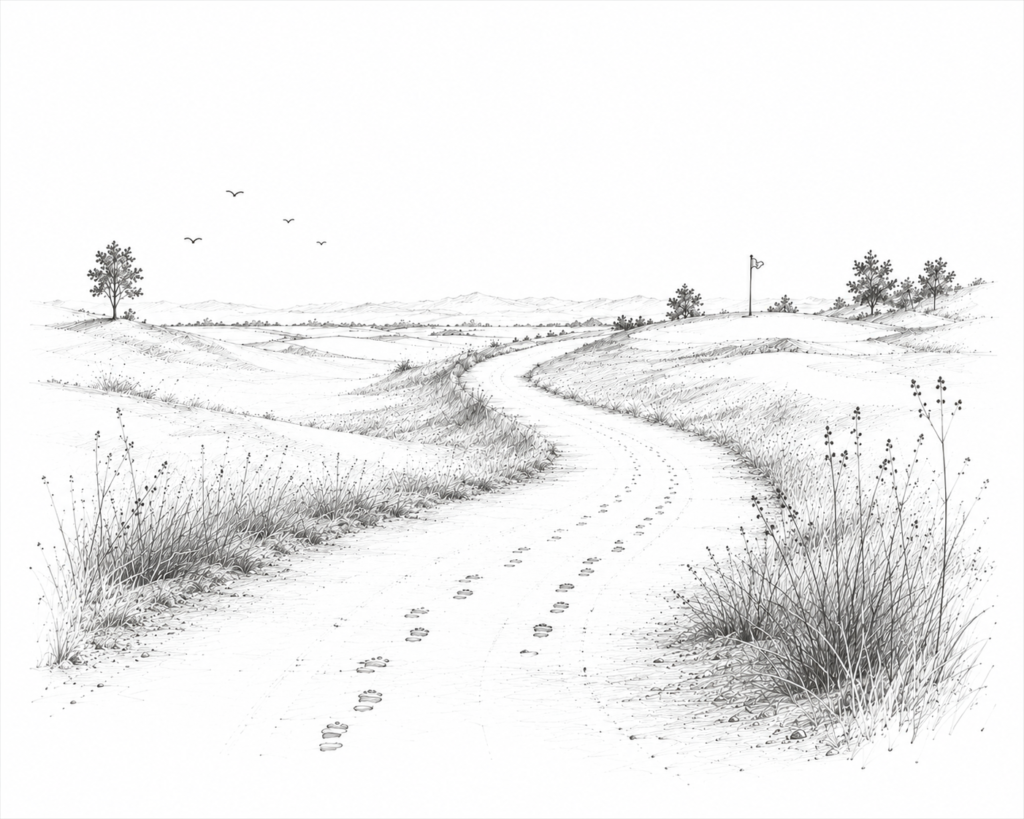
My father gave me that without a single word, on a course I haven’t played in years. I’ve been quietly handing it back out ever since — to a course at dawn, to a bunker shot I didn’t deserve, to three friends who’ve earned the right to see me tired, and now, whenever I get the chance, to whoever’s standing next to me on a tee box, about to feel something for the first time that I recognize completely, and don’t need to name out loud for either of us to know exactly what it is.
This is the first essay in Why We Play, a series about why we fell in love with this game in the first place. More essays — on Challenge, on Patience, and beyond — are coming soon.