

Nobody warned me that impatience has a tempo, or that I’d spend thirty years failing to notice it happening in my own hands, on a delay too short to feel while it’s occurring.
Here’s the frustrating part: swinging faster genuinely works, in theory. Clubhead speed produces distance — strike the ball squarely at a faster swing speed and it travels further than it otherwise would have. That’s not superstition. That’s physics, and my hands know it, which is exactly why they keep reaching for speed the moment a shot starts to matter.
What speed costs you is precision. Tempo gives a swing its structure — the sequence, the plane, the face arriving square instead of guessing. Rush the sequence and the plane goes with it; the face starts arriving late or early, open or shut, and distance stops mattering because the ball isn’t starting anywhere close to where I aimed it. More speed, less control. Every golfer knows the trade exists. Almost none of us honor it under pressure.
Here’s where the lesson refuses to stay simple. It doesn’t always fail. Sometimes I rush the transition and still catch the center of the face — the ball goes long, goes straight, and I get away with it completely. Some reptile part of my brain files that away as evidence: rushing works, you got away with it, you’ll get away with it again. Golf is disciplined enough to punish bad tempo and permissive enough to occasionally reward it anyway. If rushing failed every single time, I’d have stopped years ago. It doesn’t. So I haven’t.
The trigger is never just one thing. Difficulty does it — a tighter lie, a longer carry, water where there shouldn’t be water. Distance does it too, the specific hunger for ten more yards on a hole that needs them. And pressure does it worst of all: a first tee with people watching, a shot to catch up after a bad hole, any moment some part of me has quietly decided this one counts more than the others. Nerves and tempo turn out to be the same problem wearing two different names. Pressure doesn’t make my hands shake. It makes them hurry.
A metronome doesn’t get nervous. It doesn’t speed up because the next measure matters more, or because someone’s watching, or because it wants the song to end sooner than it’s going to end. That’s the whole humbling difference between a metronome and me.
There’s a word golf borrowed from music long before I ever thought to notice the borrowing. Tempo. It keeps the same time whether the room is empty or full, whether the moment is easy or hard. Thirty years spent trying to swing a golf club the way a metronome keeps time — steady, unbothered, indifferent to the stakes — and mostly, under real pressure, still swinging it like a man running late for a flight he already knows he’s going to miss.
I used to think this was a golf problem, something to be drilled out of me with an app and enough range balls. A coach once told me to count to two before starting down — one, two, go — and for a week it worked, until the counting became its own kind of rushing, four beats crammed into the time two used to take. I don’t have a fix for this. I’ve stopped expecting one. What I have instead is a metronome in my head I mostly ignore, and a body that still, thirty years in, reaches for speed the instant something starts to matter.
My father never seemed to need a metronome at all. I remember standing beside him on a range mat when I was young enough that the club still felt borrowed, hitting ball after ball into the grass without ever getting one airborne, and he never once told me to hurry up, never once re-teed a ball for me with anything that resembled impatience in his hands. He just waited. Teed the next one. Waited again. I whiffed, I think, ten or eleven times in a row that afternoon, and by the fifth or sixth he still hadn’t sighed, hadn’t checked his watch, hadn’t done any of the small involuntary things a person does when they’re spending patience instead of simply having it. I didn’t know at the time that I was being taught anything. I only knew nobody was rushing me toward anything, which turns out to have been the actual lesson, delivered a couple of decades before I had a name for it. Whatever kept his time arrived in him already tuned, the way some men are simply built patient. I wasn’t built that way. But somewhere underneath the frustration of that is a small, stubborn hope that the next time it happens, I might hear the click before my hands do.
FIELD NOTES
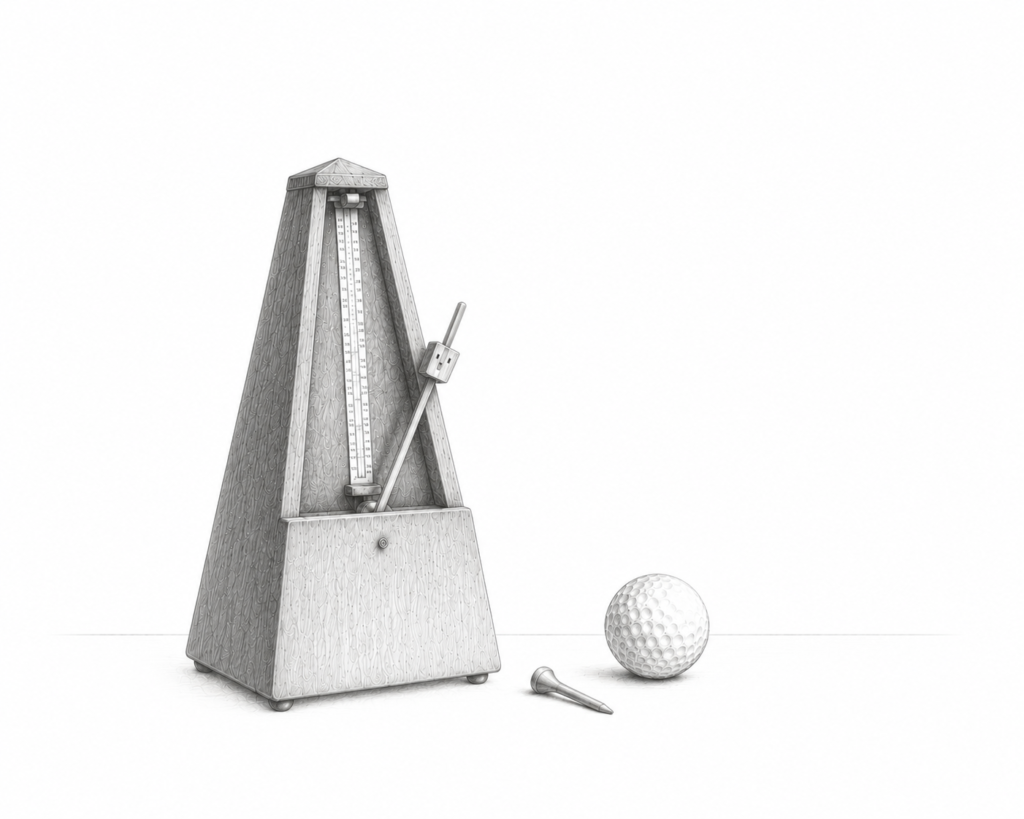
The tempo problem lives inside a swing that takes about a second and a half from start to finish, which means the whole test is over before I’ve had time to properly fail it. Blink, and it’s already happened. There’s no room in there to catch yourself — by the time I notice I’ve rushed, the ball’s already in the air doing whatever it’s going to do. The metronome in my head doesn’t get a vote in any of that. It’s already ticked, already been ignored, before I’ve had time to argue with it.
A round of golf doesn’t work that way. A round gives you four hours, sometimes closer to five, stretched out across eighteen holes and a hundred small gaps where genuinely nothing is happening — no shot to hit, no decision to make, just walking, or standing, or waiting for the group ahead to clear a green that’s taking its time clearing. That’s a different kind of patience test entirely, and a much more forgiving one, if I let it be. The swing asks for a tenth of a second of restraint I mostly fail to produce. The round asks for hours of it, spread thin — but it also gives you, unlike the swing, the chance to notice you’re failing and choose something different on the very next hole.
Nobody tells you, before you fall in love with this game, how much of it is standing around doing nothing. Four hours, and maybe forty-five minutes of it is spent actually swinging a golf club. The rest is walking, waiting, watching someone else line up a putt, standing on a tee box while the group ahead finishes a hole that’s taking longer than it should. Golf doesn’t fill the silence for you. It just hands it to you, over and over, all day, and expects you to figure out what to do with it — its own quiet test of patience, separate from anything happening in the swing itself. The swing asks for a second and a half. The round asks you to be patient with an entire afternoon that has nothing scheduled in it, no task, no deadline, just time, unspooling at its own pace whether you’ve made peace with that or not.
I didn’t used to know what to do with it. Early on, I filled every gap the way most people fill gaps now — a phone in my pocket, a quick check between shots, something to keep the quiet from becoming actual quiet. It took years before I noticed what that habit was costing me, which was the round itself. You can’t half-watch a golf course. You can’t be present for your own game while also being present for whatever’s happening forty miles away on a screen, and the difference between a round where I put the phone away and a round where I didn’t isn’t subtle. One of them I remember — the exact color of a fairway at five in the afternoon, the specific quality of quiet between shots when nobody’s rushing anybody toward anything. The other one I mostly don’t, which is its own kind of answer.
The harder test isn’t the silence you control. It’s the silence someone else imposes on you — a slow group ahead, moving at a pace that has nothing to do with your pace, turning what should be a four-hour round into something closer to five and a half, one holdup at a time. Standing on that tee box waiting, there’s nothing to do but notice things you’d otherwise walk right past. A sprinkler head ticking through its rotation somewhere down the fairway, hissing, pausing, hissing again, entirely unbothered by whether anyone’s ready for it. Two magpies working the rough near the cart path like they’ve got somewhere to be, which they don’t, any more than I do, though neither of us is willing to admit that out loud. A cart parked at an angle nobody bothered to straighten, one of the four strangers sitting sideways in it scrolling through his phone while his partner reads a putt from four different directions. The grass moving, barely, in wind you can’t otherwise feel. None of it is rushing. None of it has any reason to. The whole world keeps doing exactly what it was already doing, at exactly the pace it was already doing it, while I stand there with my hands starting to feel like they belong to someone more patient than I am.
What I’ve learned, slowly, and mostly against my own instincts, is that the slow group is not actually the problem. The problem is what I do with the extra twenty minutes I’ve suddenly been handed and didn’t ask for. Some rounds, I let it curdle into something ugly — tension I carry into my next shot, irritation that has nothing to do with the swing I’m about to make and everything to do with a group of strangers three hundred yards ahead of me who have no idea I exist, let alone that I’m furious at them. Other rounds, the same twenty minutes becomes something else entirely. A real conversation with whoever I’m playing with, the kind that only happens because neither of us has anywhere else to be and nothing else to do. A long look at a course I’ve played fifty times and never actually looked at, the way the light sits on a fairway at four in the afternoon in a way it doesn’t at any other hour. A slow round isn’t a round ruined, not to me, not anymore. It’s just a longer test — the same patience the swing asks for in a tenth of a second, stretched instead across twenty unplanned minutes, waiting on strangers who are, in fairness, probably having just as much trouble with their swings as I’m having with mine.
FIELD NOTES
The slow group tests patience aimed outward, at strangers who have no idea they’re being tested at all. That one’s almost easy, in its way, because the frustration has somewhere obvious to go. There’s a target for it, even if that target never knows they’ve been the target — the frustration exits me and lands on nobody, dissolves out over the fairway, and I get to walk to my next shot feeling lighter for having had somewhere to put it.
The harder version doesn’t give me anywhere to point. It shows up on mornings I’ve handed myself a bad start entirely on my own — three bogeys and a double through the first five holes, no slow group, no bad bounce, nothing external to blame, just me, playing worse than I know I’m capable of. That’s when patience stops being about waiting for someone else to hit their shot and starts being about something harder: waiting for myself to be better again, without any guarantee that I will be. This is the same rushing that ruins a transition, just stretched out over thirteen holes instead of a second and a half — my hands wanting to fix in one swing what should only ever be earned back slowly, one solid shot at a time.
Golf gives you that choice more than almost any other game does. A bad first quarter in most sports is just a bad first quarter — the deficit is real, and there’s rarely enough time left to erase it. A round that starts badly hasn’t ended badly. It’s just started badly, and the only way through it is the one thing impatience never wants to do: nothing dramatic. Just the next shot, played the same way as if the first five hadn’t happened at all.
FIELD NOTES
I shot eight over on a front nine that had no business going that badly. Nothing dramatic happened — no single disaster hole, no lost ball that changed everything, just a slow accumulation of small failures, a three-putt here, a pulled iron there, the particular misery of a round falling apart one unremarkable mistake at a time instead of one big one. By the ninth green I had the familiar urge to just start swinging harder. Chase it. Find the eight strokes back all at once, in one heroic drive, one reckless line at a flag I had no business attacking.
The walk from the ninth green to the tenth tee took four minutes, maybe five, and nothing happened during it — no conversation worth remembering, no decision announced out loud, just the ordinary business of finding a cart and driving across a path lined with the same trees I’d walked past a hundred times before. That walk is where the round actually got decided, not on any swing before or after it. I spent it having an argument with myself that never quite reached the surface — one version of me already reaching for the driver, already rehearsing the swing that would go find the eight strokes tonight, this hole, immediately, and a quieter version underneath that one just repeating, without much conviction at first, that thirteen holes was still thirteen holes, that nothing was actually lost yet except the numbers. Nobody watching me during that walk would have seen anything at all.
That’s the part about patience I didn’t understand until much later — it doesn’t look like anything from the outside. It isn’t a swing you can see, or a decision you announce. It’s just a quieter version of you, slowly winning an argument with a louder version of you, somewhere in a golf cart on the way to the next tee, where nobody else will ever know it happened.
I didn’t chase it. I’ve learned, slowly and expensively, that chasing is almost always how a bad nine becomes a genuinely terrible eighteen, so I did the thing that felt like doing nothing, which is usually the hardest thing available to a person who’s angry at himself. I played the tenth hole exactly like I would have played it if the front nine had gone well. Same club. Same target. Same pace, even though everything in me wanted to speed up and force the math back into my favor immediately.
There’s a moment on that tenth hole I still remember clearly, standing over a routine seven-iron I’d hit a thousand times before, feeling the pull to take one extra club and swing easy, to steal back a few yards through cleverness instead of patience. I didn’t. I hit the club the yardage actually called for, at the pace I’d hit it a thousand times before, and it landed exactly where it was supposed to — the metronome in my head, for once, actually keeping time instead of getting ignored. It felt, disproportionately, like relief. Not because the shot was special. Because it was ordinary, and ordinary was exactly what I needed after a front nine that had talked me into believing ordinary wasn’t going to be enough anymore.
The back nine went one under.
I wish I could tell you there was a single turning moment, a shot that flipped a switch, but there wasn’t. It was quieter than that — mostly the absence of something. The absence of forcing, the absence of trying to manufacture in one swing what would only ever come back one solid shot at a time, if it came back at all. I made a couple of putts I’d been missing all morning, not because anything technical changed, but because I stopped needing them to drop and started just trying to hit them well, which is a distinction that sounds meaningless until you’ve felt the difference between a nervous putt and a patient one from the inside. The round isn’t over when it starts badly. It’s only over when you decide it is, and that decision, it turns out, is entirely about patience and not at all about talent. The eight strokes didn’t come back because I found something. They came back because I stopped looking for it so hard, and let thirteen holes — thirteen, then nine, then just the next one — be enough time for something to return on its own.
Every kind of patience so far has had an expiration date built into it. The tempo problem resolves in a second and a half, however it resolves. The slow group eventually plays on. A bad front nine only has nine more holes to answer for itself before the round ends and you drive home, done with it either way. Even at its longest, every version of patience I’ve described has come with a clock running underneath it, some finish line I could see from the start, even if I couldn’t always see myself reaching it gracefully.
There’s a slower version that doesn’t come with an ending built in at all — one that unfolds over years instead of hours, where the person you’re being patient with isn’t a stranger three hundred yards ahead of you, and isn’t even yourself. It’s someone you love, standing next to you, holding a golf club for the first time, or the fiftieth time, still not quite getting the thing you’re trying to hand them. There’s no ninth hole where this one resolves. There’s no drive home at the end of it. It just continues, season after season, for as long as they’re willing to keep showing up and I’m willing to keep trying to teach them something I’ve never had to put into words before.
I know what patience looks like on the receiving end of that. I learned it on a mountain, a long time ago, from a man who gave it to me without a single word. What I didn’t know, until I tried to give it to my own family, is how much harder it is to hand someone a working metronome when you’re still, most days, learning to keep time with one yourself.
FIELD NOTES
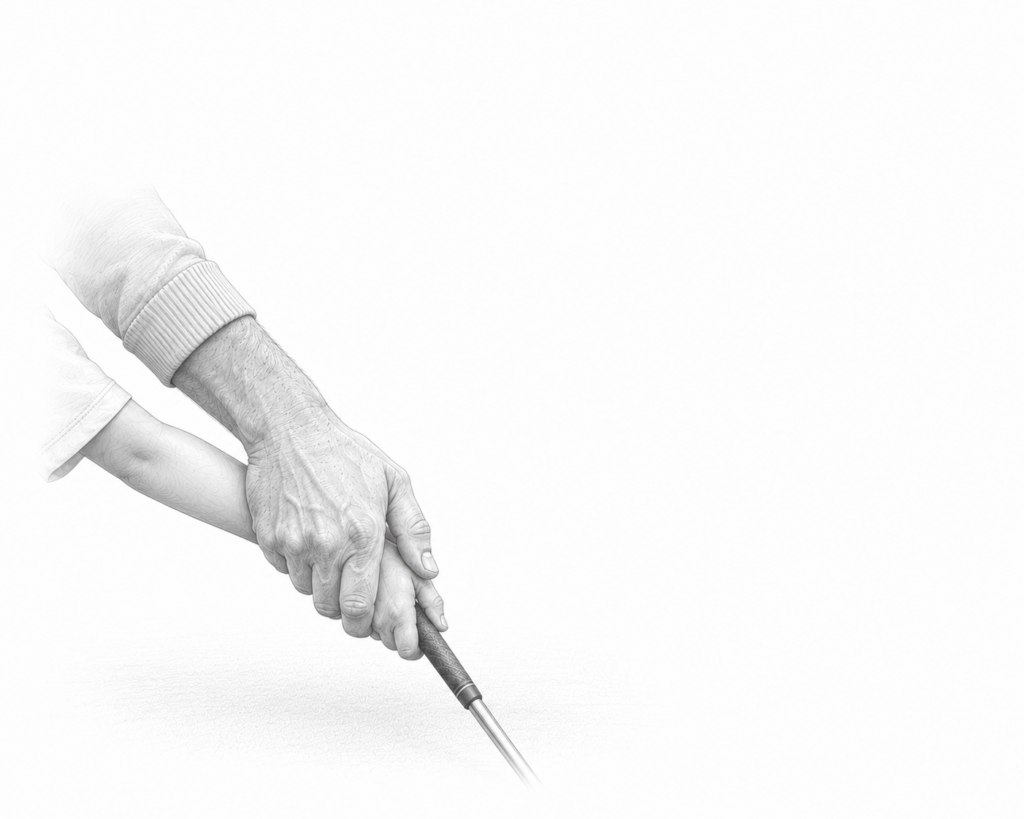
I have spent three years, on and off, trying to teach three people I love how to play a game that took me a lifetime to only partially understand myself, and the not-fully-understanding-it-myself part turns out to be the whole problem.
I’ve stood behind my son, a second grader, hands too small for the grip we’ve cut down twice already, and tried to explain something about the golf swing that I’ve never once successfully explained to myself, using words I’m not even sure are correct, because the truth is I don’t swing a golf club by understanding it — I swing it by feel, by thirty years of accumulated instinct I’ve never had to translate into language before. I’ve watched my daughter, twelve, arrive at the range with a posture that says she’s already decided this isn’t going to go well, and I’ve tried to find the words to tell her otherwise, and mostly failed, because I’m not sure I entirely believe my own advice most days either. I’ve stood next to my wife, fifteen years married, watching her fight a slice that has nothing to do with effort and everything to do with a golf swing being one of the strangest, least intuitive physical motions a human body is ever asked to perform, and I’ve tried to teach her the same feel I’ve spent decades building for myself, in an afternoon, using instructions I’m inventing on the spot.
I tried giving my son the same count I once got from a coach — one, two, go — thinking a rhythm simple enough for me to fail at might be simple enough for an eight-year-old to actually use. He counted so fast the two numbers arrived almost on top of each other, which, if I’m honest, is exactly what I do under pressure, just slower and with better cover. My daughter refused the count entirely. Counting made her more nervous, not less, she said, and she was right — it does the same thing to me most weeks, I just never admitted it out loud until she did. My wife took to it immediately, better than I ever have, which she will absolutely never let me forget.
Patience, it turns out, isn’t only about waiting for someone else to improve. It’s about tolerating how much of what I know, I don’t actually know how to teach — standing next to someone I love, watching them struggle with something I’ve internalized so completely I can no longer see its individual parts, and resisting the urge to just take the club and show them, which would rob them of the only thing that actually builds a swing: time, repetition, and enough patient failure of their own to eventually find whatever feeling I never had proper words for either.
Some days it works anyway, despite my teaching rather than because of it. My son catches one clean, purely by accident, and there’s a specific sound to it even from a cut-down junior club — a sharper click than his usual mis-hits, small but unmistakable, the kind of sound that makes both of us look up at exactly the same moment. His face does something I wasn’t prepared for the first time I saw it happen: not a smile, not right away, more like confusion, as if his own body had done something without asking his permission first, and he isn’t sure yet whether he’s allowed to take credit for it. Then he reaches for another ball almost immediately, already trying to make it happen twice, which is the part that gives away he doesn’t yet know why the first one was different — he thinks it’s a thing you can simply decide to repeat, the way you decide to raise your hand in class. Some part of me wants badly to explain that it doesn’t work that way, that he just brushed up against a feeling that took me three decades to even name, and that chasing it on the very next swing is almost guaranteed to make it disappear again. I open my mouth to say some version of that. And then I close it again, because I recognize, from the inside, exactly what it would do to him to hear it — it would turn the one pure, uncomplicated good feeling he’s had all afternoon into a lesson, and lessons are precisely the thing standing between a kid and doing something again by accident. So I say nothing. I let him take his second swing, miss it entirely, the way you’d expect, and I watch his face do something closer to disappointment this time, and I still say nothing, because the only thing that actually matters in that moment is getting out of the way of whatever he’s feeling, the way my father got out of the way of mine, on a range a very long time ago, without ever once explaining why.
My daughter hit three balls in a row cleanly on a Tuesday in June, better contact than she’d managed in a month, and instead of the reaction I expected, she just stood there a second, watching the ball still rolling to a stop out on the range, and said, quietly, almost to herself, okay, so I can do that. Not excited. Not asking me to confirm it. Just filing it away, the way you’d file away a fact you’d been quietly arguing with yourself about for weeks and finally had proof of. She didn’t ask what I thought. She didn’t even look over at me, which I noticed, because it was the first time in months of lessons that she hadn’t immediately turned to check my face for a verdict before deciding how to feel about her own shot.
My wife hit a drive one Saturday that outran mine by ten yards, which has never happened before and, based on her face, was never going to be allowed to happen quietly. She didn’t say anything about her tempo, or her transition, or any of the things I’d spent months trying to explain to her. She just looked down the fairway at where both balls had landed, looked at me, and started walking toward the cart at a pace that could only be described as smug. I didn’t say a word the rest of the hole. Some lessons, it turns out, don’t need me in the room at all.
Three people I love, three completely different shapes of patience required, and none of them the shape I would have guessed I’d need before I started trying to teach any of them.
I don’t think this game ever finishes teaching you patience, any more than it finishes teaching you the swing. I still rush under pressure. I still want a bad start back all at once instead of one hole at a time. I still catch myself out of patience with a twelve-year-old who is, in fact, allowed to be twelve. But I notice it now — more of the time than I used to — which might be the only progress available in something like this: not the arrival at patience, but the slowly growing ability to hear the click a half-second sooner than I used to, and choose, again, to wait.
My father never had to make that choice. Whatever kept his time seemed to arrive in him already tuned, the way some men are just built quiet, built patient, without ever having to practice at it a day in their life. I wasn’t built that way, and for a long time I thought that made me the lesser student. I don’t think that anymore.
Whatever patience I have, I’ve built by hand — badly, slowly, mostly in front of the people I love most, failing at it and trying again the next round. That might be the actual inheritance. Not his stillness. The permission to keep earning my own.
FIELD NOTES
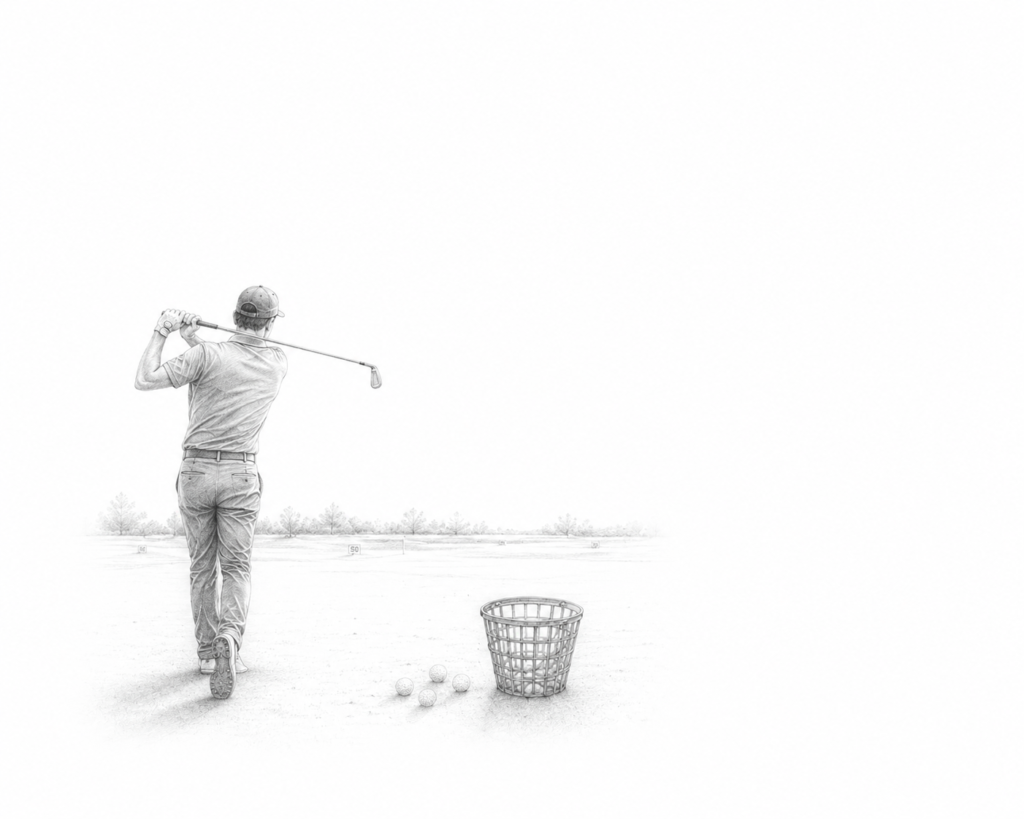
Some evenings, after everyone’s put their clubs away and gone inside, I’m still out on the range alone, hitting the last few balls into a light that’s nearly gone, thinking about how differently patience shows up in the three people I love most — my son needing silence, my daughter needing words, my wife needing only enough room to trust her own hands. None of them needed the same thing from me. None of my old lessons were ever going to be enough on their own. So I keep relearning it — in a swing, in a round, in a bad nine holes, in whatever my son or daughter or wife needs from me that particular evening — the same discipline, a hundred different tempos, and me still out here, most nights, trying to find the beat.
This is the third essay in Why We Play, a series about why we fell in love with this game in the first place. Catch up on Joy and Challenge. More essays are coming soon.