
What do you call someone who finishes top-five in all four major championships in a single season but wins none of them? Who ties a U.S. Open scoring record, spends fifteen years as one of golf’s most recognizable figures, and still lives perpetually close to everything the sport supposedly values most—yet never quite grasping it?
The easy answer: unfulfilled potential, cautionary tale, the guy who almost made it.
“The true answer requires understanding something American sports culture resists: that some careers matter precisely because they refuse to resolve into the clean narratives we demand.”
The true answer requires understanding something American sports culture resists: that some careers matter precisely because they refuse to resolve into the clean narratives we demand, that excellence without validation might be more instructive than triumph, that the space between promise and completion can be where the most authentic lives are built.
Rickie Fowler has spent fifteen years inhabiting this peculiar territory—a place where excellence and expectation engage in an excruciating dance, where being perpetually ‘almost’ becomes not a failure to arrive but a different kind of destination entirely. His story defies the binary framework that governs most athletic narratives—triumph or catastrophe, breakthrough or breakdown, hero or cautionary tale.
Zac Efron is the counter-melody in Fowler’s score—the proof that charisma and craft aren’t enemies. Across five transformative films, Efron has mapped territory that Fowler navigates on golf courses worldwide—the space between manufactured image and authentic self, between what the market demands and what the artist can deliver, between being packaged as a product and remaining recognizably human.
The parallel isn’t forced; it’s revelatory. Both men arrived as fully formed concepts before they’d earned the credentials, both spent years being dismissed as style over substance, and both ultimately proved that authenticity and commercial appeal aren’t opposing forces but dimensions of the same pursuit.
Career Achievement Summary
| Category | Achievement |
|---|---|
| Major Championships | 0 (multiple top-5 finishes, including top-5 in all four majors in 2014) |
| PGA Tour Victories | 6 (including 2015 Players Championship, 2023 Rocket Mortgage Classic) |
| Peak World Ranking | No. 4 (2016) |
| Signature Achievement | Top-5 in all four majors (2014)—third player ever; tied U.S. Open single-round scoring record (62) in 2023 at Los Angeles Country Club |
| Cultural Footprint | Transformed golf’s demographic appeal; brought youth culture into the sport |
The Manufactured Dream
High School Musical: When Image Precedes Achievement
Kenny Ortega’s High School Musical (2006) finds Troy Bolton (Zac Efron) caught between two stages, two audiences, two completely incompatible versions of who he’s supposed to be. His face at the championship free-throw line—pure terror masked as cool indifference—captures someone discovering he possesses talents that complicate the identity everyone has already assigned him.
Rickie Fowler occupied this exact position when he arrived on the PGA Tour in 2010.
Born December 13, 1988, in Murrieta, California, Fowler grew up in Southern California’s Inland Empire—X Games country, where style mattered as much as winning. His grandfather, Yutaka Tanaka, introduced him to golf at age three at Murrieta Valley, a public facility where accessibility mattered more than tradition.
By age eight, Fowler was showing up to junior tournaments in skateboard shoes and backwards caps, his golf bag decorated with motocross stickers while other kids carried pristine equipment their country club pros had selected. The game he learned was filtered through youth culture rather than golf’s historical conventions.
The flat-brimmed caps weren’t golf accessories—they were skateboard culture translated to fairways, visible proof that golf could speak the language of youth without irony. His coaches recognized something unusual: a kid who could translate action sports’ athletic confidence into golf’s precision demands.
When Fowler turned professional, he arrived as a fully formed concept rather than an evolving prospect—flat-brimmed caps, Oklahoma State orange, and a motocross-infused swing that traded prettiness for power. He wasn’t just a golfer; he was a demographic argument—a bridge between golf’s aging audience and youth culture.
When Puma signed him in 2009, the message was unmistakable: this was the future of golf.
Early Validation: Promise Meeting Performance
Key early achievements:
- 2009 Walker Cup (Merion): 4-0-0 record, fist pumps that belonged to action sports rather than genteel tradition
- 2010 Waste Management Phoenix Open: Runner-up finish as a rookie, galleries recognizing someone who looked like them
- 2010 season: Rookie of the Year honors, Ryder Cup selection despite not having won on tour
- 2012 Wells Fargo Championship: Playoff victory over Rory McIlroy—first PGA Tour win
The 2012 Wells Fargo Championship provided real validation: a playoff victory over Rory McIlroy and D.A. Points that should have announced Fowler’s arrival as a legitimate contender rather than just a talented marketer. The playoff lasted just one hole. Fowler hit a 133-yard gap wedge to four feet and made the birdie putt, center-cut, his first PGA Tour victory.
“But here’s the thing about arriving as a fully formed concept: it means the pressure to validate the concept precedes the actual validation.”
But here’s the thing about arriving as a fully formed concept: it means the pressure to validate the concept precedes the actual validation. Fowler spent his early professional years performing the role of “golf’s youth ambassador” so thoroughly that it became unclear whether an authentic self existed beneath the marketing construct.
He would bring new audiences to the game, make it more accessible and less intimidating, serve as a bridge between traditional golf culture and the broader athletic landscape.
These were real achievements with genuine cultural value. But they also meant that his athletic accomplishments would always be evaluated against impossible standards, that every victory would be examined for whether it validated the marketing narrative rather than simply celebrated on its own terms.
Troy Bolton’s integration never fully resolves in High School Musical—the film ends before we know if he can sustain being both. Fowler’s early professional years established similar uncertainty: he had successfully brought youth culture to golf, but could he also win majors? Could he be both ambassador and champion?
The answer would arrive in 2014, and it would be more complicated than anyone expected.
The Education of Almost
17 Again: The Gap That Never Closes
Burr Steers’ 17 Again (2009) presents Mike O’Donnell (Matthew Perry/Zac Efron) seeing his pregnant girlfriend in the stands during the championship game and walking off the court mid-game, choosing love over ambition, family over glory.
Two decades later, he spends every day wondering what would have happened if he’d taken that final shot. The gap between who you are and who you might have been never closes—it just changes shape.
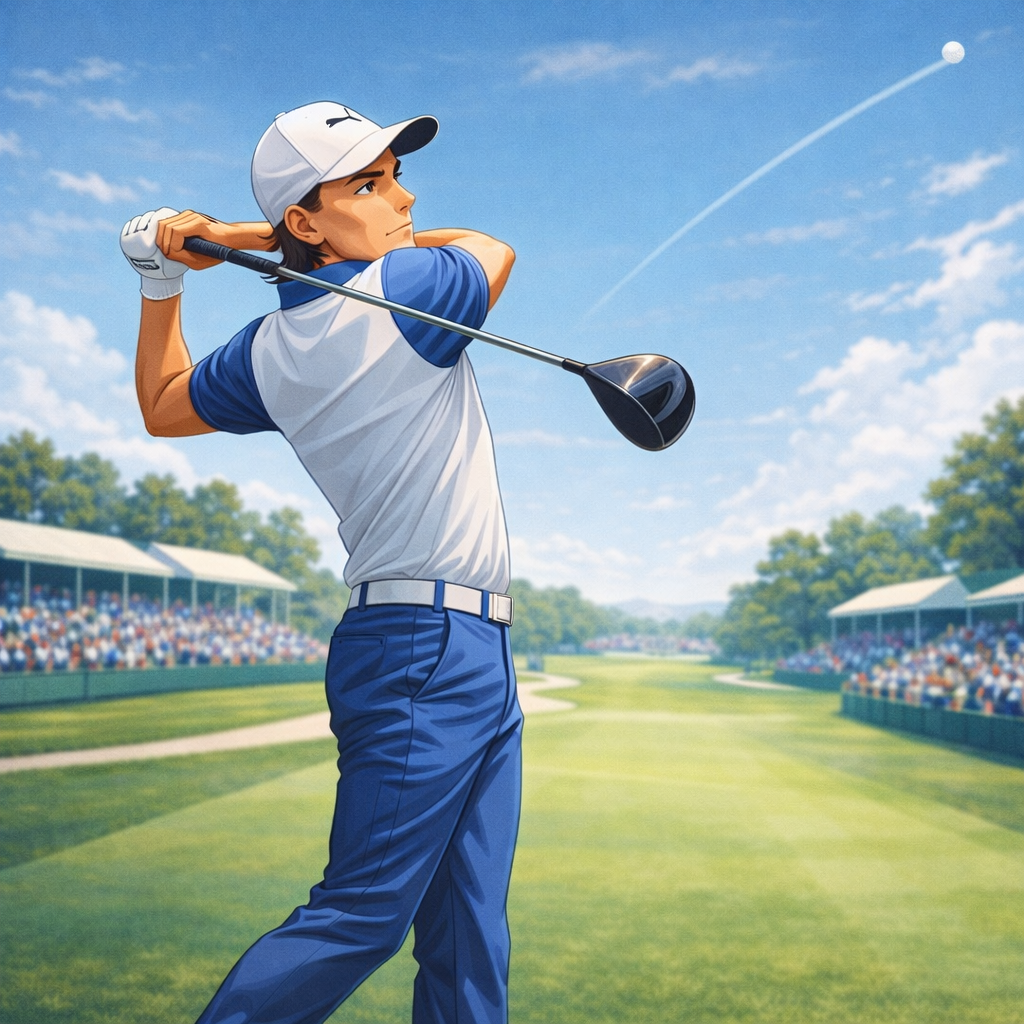
For Rickie Fowler, 2014 became the most eloquent statement in the modern vocabulary of “almost.”
The Year of Almost: A Mathematical Breakdown
| Tournament | Finish | Margin | Final Round | Key Moment |
|---|---|---|---|---|
| The Masters | T-5 | 6 strokes | 73 (+1) | Career-best 67 on Saturday, then Sunday faltered |
| U.S. Open | T-2 | 8 strokes | 72 (E) | Double-bogey at 4th ends chances |
| The Open | T-2 | 2 strokes | 67 (-3) | First player to shoot all four rounds in the 60s at an Open and NOT win |
| PGA Championship | T-3 | 2 strokes | 68 (-2) | Missed 50-foot eagle try in darkness as McIlroy prevails |
| AGGREGATE | Top 5 in all four | Never closer than 2 strokes | -4 combined | Historic company, no trophy |
Eighteen shots across four majors separated Fowler from an entirely different career—the razor-thin margin between historic season and historical footnote.
“This is the mathematics of almost—close enough to prove you belong, far enough to question whether you’ll ever arrive.”
This is the mathematics of almost—close enough to prove you belong, far enough to question whether you’ll ever arrive.
Pinehurst: The Education Begins
The Masters in April: T-5, six strokes behind Bubba Watson, his Saturday 67 raising hopes before Sunday’s 73 extinguished them.
The U.S. Open at Pinehurst No. 2 arrived in June with Martin Kaymer dominating after opening with consecutive rounds of 65—the first time any player had started a major with back-to-back rounds of 65 or better.
After opening 70-70, Fowler’s Saturday 67 moved him into Sunday’s final pairing, five back. This was it: his first time in the final group of a major championship, paired with the leader, with a chance to chase down a U.S. Open.
But Sunday at Pinehurst brought reality rather than fairy tale.
The 4th hole delivered his education. His tee shot found unplayable pine straw beneath low branches. After a penalty drop, his recovery skipped through the green. Two chips later: double-bogey. The five-stroke deficit became seven. The dream of catching Kaymer vanished into the Carolina pines.
Walking to the 5th tee, Fowler’s expression revealed something more complicated than simple disappointment. This was education, not failure—learning what major championship pressure feels like when everything compounds, when one bad swing cascades into catastrophe, when the margin between contending and spectating can be measured in inches of pine straw.
He steadied himself immediately, playing solid golf the rest of the way. His closing 72 left him at 1-under par for the championship—good enough for T-2 alongside Erik Compton, but a full eight strokes behind Kaymer’s commanding victory.
Only three players finished under par for the week at Pinehurst’s restored No. 2 course.
‘I felt really comfortable,’ Fowler said afterward. ‘The more experience you can get in final groups at majors—it definitely helps for down the road.’
Down the road. That phrase carries weight when you’re 25 years old and the road still stretches long in front of you, full of possibility. It carries different weight at 36, when you can see the horizon line more clearly, when “down the road” starts to mean something finite rather than infinite.
Valhalla: Darkness and Almost
At Royal Liverpool for The Open, he improved daily (69-69-68-67), finishing two back of McIlroy. First player ever to shoot all four rounds in the 60s at The Open Championship and not win. Another historic footnote, another marker of excellence that carried no trophy.
The PGA Championship at Valhalla in August brought the most dramatic finish yet.
Fowler entered the final round two shots behind leader Rory McIlroy. After early bogeys dropped McIlroy back, Fowler surged with four birdies on the front nine to take the outright lead at 15-under through 10 holes.
But McIlroy answered with an eagle on the par-5 10th—a 3-wood from 284 yards that settled seven feet from the hole—to vault back into contention. McIlroy added birdies on 13 and 17 to reclaim a two-stroke lead with one hole to play.
In near darkness after rain delays, an unprecedented sequence unfolded—players hitting out of order to complete the championship. McIlroy parred from a bunker for victory at 16-under. Fowler’s 68 gave him T-3 at 14-under.
It was Fowler’s fourth top-5 finish in the four majors of 2014—historic company (Nicklaus in 1971, Woods in 2005), but no trophy. The margin was one stroke from second, two from victory, and the lingering question remained: when would proximity become triumph?
The Psychology of Perpetual Almost
The psychological territory of almost is more complex than simple disappointment.
When you fail dramatically—when you shoot 80 in the final round, when you miss a two-foot putt, when you collapse under obvious pressure—at least the narrative is clean. You weren’t good enough in that moment, and everyone can see why.
But when you play brilliantly and still fall short, when you execute at elite levels and the outcome remains just beyond reach, it creates a more insidious form of doubt.
Because the questions don’t come from critics—those are easy to dismiss. They come from the mirror at 3 AM.
“Maybe you’re good enough to belong in every conversation but not good enough to win any of them. Maybe proximity is your ceiling rather than your floor.”
Maybe you’re good enough to belong in every conversation but not good enough to win any of them. Maybe proximity is your ceiling rather than your floor. Maybe the marketing was wrong—maybe you’re not destined for greatness, just competence with excellent branding.
This is where almost becomes cruel—not in its volume but in its persistence, not in its accusation but in its question mark.
The criticism was blunt. Golf writers questioned whether style was masking substance. Television analysts wondered aloud whether he had ‘what it takes’ to win majors. The 2015 anonymous player poll that ranked him the most overrated player on tour crystallized what critics had been suggesting: that the marketing had outpaced the achievements, that the flat-brimmed cap was hiding an uncomfortable truth about unfulfilled potential.
What distinguished Fowler’s response from other athletes’ reactions to crushing disappointment was his refusal to adjust his public persona to match the narrative expectations.
Where others might have grown defensive or withdrawn, Fowler maintained the same approachable authenticity that had defined his early career. The smile remained genuine. The interactions with galleries stayed warm. His signature style still appeared on Sundays.
This consistency confused observers who expected visible suffering as proof of competitive fire. The alternative possibility—that he could be both genuinely disappointed and still fundamentally content with his life—didn’t fit conventional athletic narratives about sacrifice and suffering as prerequisites for excellence.
Mike O’Donnell discovers that the life he chose—the one everyone told him was second-best—held more truth than the fantasy everyone imagined for him.
As 2014 ended, Fowler confronted similar terrain: How do you build a meaningful life in the space between what you achieved and what you almost achieved? How do you find peace with proximity when being close feels like it should have been completion?
For a while, Fowler lived in that question. The season that had promised everything left him famous for what he didn’t win, a paradox that would shadow every swing that followed.
In golf, there’s no ceremony for almost—no banner, no trophy, just silence where celebration should be.
What he discovered, slowly and painfully, was that “almost” doesn’t vanish when you move on; it migrates, shaping how you approach everything that comes next. Before he could climb again, he would have to learn how to exist in that emptiness—to build something steady on the space between.
The Wilderness Years
We Are Your Friends: The Slow Accumulation of Almosts
In Max Joseph’s We Are Your Friends (2015), Cole Carter (Zac Efron) possesses genuine talent but lacks the breakthrough that will lift him from local clubs to festival main stages.
The film’s most devastating sequence comes not during dramatic failure but in the slow accumulation of almosts: the demo that almost gets played, the connection that almost leads somewhere, the moment that almost becomes the moment.
The Players Victory: Silencing Critics (Briefly)
But first came the validation that critics said would never arrive.
The 2015 Players Championship victory proved Fowler could deliver under maximum pressure. The 2016 season brought four runner-up finishes and a climb to number four in the world ranking. The 2017 Honda Classic victory demonstrated continued competitiveness.
These weren’t flukes or fortunate breaks—these were earned victories against world-class fields that should have silenced the “overrated” chorus.
Instead, they raised the expectations even higher, which made what followed even more disorienting.
The Physical Breakdown
Rickie Fowler’s struggles began subtly, then accumulated into something more ominous.
The right oblique strain that emerged in 2018 wasn’t dramatic—no single catastrophic moment, just a gradual degradation of the physical foundation his swing required. Fowler said it ‘occurred over time,’ though he remembered first feeling it on a 6-iron at the WGC-Bridgestone in Akron that August.
Swing modifications felt foreign, compensation patterns created new problems, and slowly he realized that the athletic motion that had defined his game might no longer be available.
He won the Waste Management Phoenix Open in 2019, proving he could still compete at the highest levels. The victory came in typical Fowler fashion—a final-round 74 that somehow held off challengers. Yet even then, swing adjustments that worked until they didn’t hinted that something fundamental needed addressing.
The decline in numbers:
- 2020: Fell to 26th in the world
- 2021: Dropped to 128th
- September 2022: Career-low 185th
The decline wasn’t dramatic but a steady erosion—missed cuts accumulating, withdrawals multiplying, his swing looking increasingly tentative on video.
The Loneliest Walk
A Friday afternoon at the 2021 Wells Fargo Championship: Fowler shot 70-77, missing the cut at the same tournament where he’d won nine years earlier.
He signed autographs, posed for photos, answered questions with his characteristic warmth. Then walked to the parking lot alone, loaded his clubs, and drove away while the weekend’s contenders prepared for rounds he wouldn’t play.
“That walk—from center of attention to invisible—captured professional sports’ particular loneliness. Nobody sees you leave. Nobody marks the moment.”
That walk—from center of attention to invisible—captured professional sports’ particular loneliness. Nobody sees you leave. Nobody marks the moment. You’re just suddenly gone, and the tournament continues without you, and the galleries that once followed your every shot are now three fairways over, watching someone else.
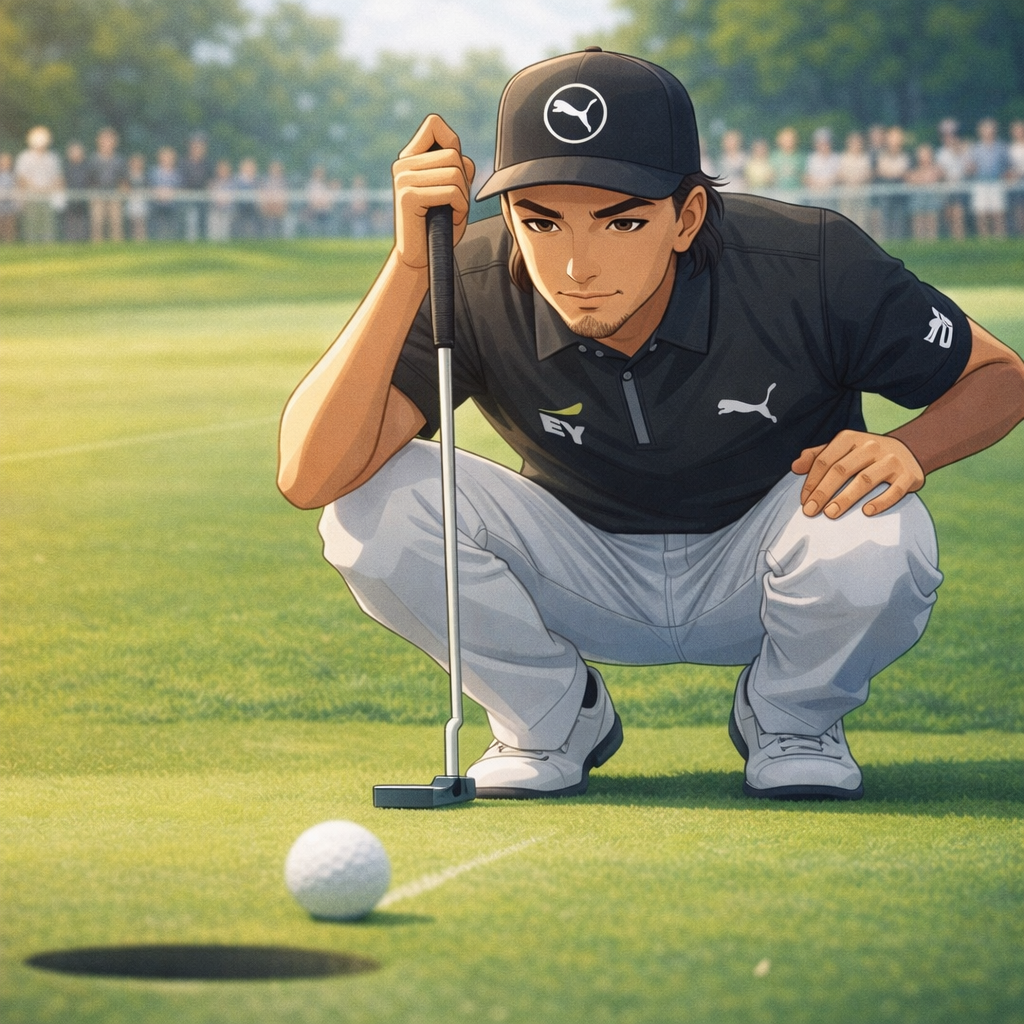
He’d try to redirect his thinking toward technical solutions—maybe a different shaft, maybe an adjustment to his setup, maybe a new trainer who could solve the physical issues.
But beneath the practical problem-solving lurked the existential dread: that some careers simply end, not with dramatic injury or scandal but with a slow fade into irrelevance, becoming a guy people used to talk about.
The Complete Reset
During the 2022 season, Fowler made significant personnel changes:
Team overhaul:
- August 2022: Parted ways with longtime caddie Joe Skovron (13 years together), replaced him with Ricky Romano
- Off-season: Moved on from swing coach John Tillery, returned to former instructor Butch Harmon
The changes signaled a complete reset—new eyes, new voices, a new approach to solving problems that had seemed unsolvable.
The worst moments came when he’d hit balls on the range and feel glimpses of his old swing—thirty seconds where everything clicked, where the motion felt athletic and free, where he could see the player he used to be emerging from beneath all the compensation.
Then it would disappear, usually within ten swings, leaving him with the reconstructed motion that produced inconsistent results and a quiet, growing panic that maybe this was permanent.
What Sustained Him: Family as Foundation
His marriage to Allison Stokke in October 2019—a former pole vaulter who had set a US freshman high school record at age 15, someone who understood athletic identity and its fragility—provided different ballast.
She had married him knowing what professional athletics demanded, understanding that his world ranking was already declining, choosing him when the wilderness was beginning rather than after he’d emerged from it.
Their home became a place where professional golf was something he did rather than everything he was. She never asked about his round unless he wanted to talk about it. She never checked his world ranking. She simply loved the person who happened to play golf professionally, making clear that his worth to her had nothing to do with tournament results.
The birth of their daughter Maya in November 2021 recontextualized everything.
Holding his infant daughter during his professional struggles, Fowler understood with sudden clarity that his worth to her wasn’t determined by world ranking or major championships. She would love him whether he ever won another tournament or not. This realization was simultaneously liberating and clarifying.
Bath Time with Maya: The Real Reset Button
Maya’s presence transformed the wilderness from crisis into context. Yes, his golf career was struggling. Yes, the rankings told a story of decline. But every night, he came home to someone who thought he was the most important person in the world—not because of what he’d accomplished but simply because he was Dad.
Her giggles when he made silly faces. Her tiny hand gripping his finger. The way she looked at him with complete trust and zero judgment about his golf game.
“Every evening at home, he’d give her a bath—splashing games that soaked his shirt, rubber ducks that had to be arranged in precise order (her rules, not his), and the inevitable battle over getting out.”
Maya’s nighttime routine became Rickie’s reset button. Every evening at home, he’d give her a bath—splashing games that soaked his shirt, rubber ducks that had to be arranged in precise order (her rules, not his), and the inevitable battle over getting out.
Wrapped in her towel, she’d sit on his lap while Allison brushed her hair, and Rickie would make up stories about a golf ball named Ricky (her pronunciation) who had adventures at different courses.
The stories were terrible—he knew this—but Maya thought they were the greatest thing ever created. In those moments, his world ranking didn’t exist. The missed cuts didn’t matter. He was just Dad, telling bad stories to someone who thought he was perfect exactly as he was.
He was 33 years old, which isn’t old in golf terms but old enough to see the horizon line more clearly, to understand that professional athletic careers contain more past than future, to wonder if the best days might already be behind him.
The question throughout this period wasn’t whether Fowler would survive—financially secure through years of endorsements, happily married, with interests beyond golf, survival was assured.
The question was whether he could recover what had been lost, whether the player who had finished top-five in all four majors still existed somewhere beneath the injury and compensation and doubt, whether resurrection was possible or whether he was watching in real time as his competitive career concluded with a whimper rather than a bang.

The Resurrection
The Iron Claw: Refusing to Let Tragedy Write the Final Word
Sean Durkin’s The Iron Claw (2023) tells the tragic story of the Von Erich wrestling dynasty. Kevin Von Erich (Zac Efron), the last surviving brother, carries unimaginable grief but refuses to be consumed by it.
Efron’s performance captures a man who chooses to continue—to keep wrestling, to build a family, to find joy despite everything—which becomes a form of meaning-making, a refusal to let tragedy have the final word.
Los Angeles Country Club: The Historic 62
The U.S. Open at Los Angeles Country Club in June 2023 provided the first hint that Fowler’s story wasn’t finished—that the narrative everyone had written about decline and graceful acceptance might have been premature.
He hadn’t won on tour in four years, 1,610 days. His world ranking remained outside the top 50. Expectations were modest—make the cut, play respectably, show that the work was producing results even if victories remained distant.
Then Thursday happened, and everything changed.
The opening round 62 tied the lowest score in major championship history—a mark previously reached by Branden Grace at the 2017 Open Championship and matched by Xander Schauffele at both the 2023 U.S. Open and 2024 PGA Championship.
This wasn’t lucky bounces or a hot putter masking sloppy ball-striking—this was comprehensive excellence:
- Ten birdies against just two bogeys on the par-70 layout
- Irons finding greens with precision he hadn’t shown in years
- A swing that looked athletic and free rather than reconstructed
Each birdie felt like reclamation—proof the player who once contended in majors wasn’t gone, just dormant. Starting on the back nine, he strung together four straight birdies, kept stacking chances, and reached ten birdies to seal the historic 62. The two bogeys barely registered against the brilliance of the performance.
As he left the 18th green, Fowler’s smile contained something different from the relief that had characterized his comeback moments during the wilderness years.
This was pure joy—the expression of someone who had rediscovered something he thought might be permanently lost, who had proven to himself (everyone else was secondary) that the player who had contended in majors still existed beneath all the injury and compensation and doubt.
The weekend brought its own challenges. Rounds of 70-75 were solid but not enough to challenge eventual winner Wyndham Clark and runner-up Rory McIlroy. Fowler would ultimately finish T-5, earning $738,934 and cementing his exemption status.
But the outcome mattered less than the announcement: the 62 had proven the reconstruction had produced something sustainable, something that could compete at golf’s highest level.
Detroit: The 1,610-Day Drought Ends
The Rocket Mortgage Classic in Detroit arrived in July carrying different energy than any tournament Fowler had played in years. The 62 at the U.S. Open had changed the narrative from “can he survive?” to “can he win again?”
Sunday in Detroit became the moment that transformed comeback into resurrection.
Fowler opened with rounds of 67-65-64 to position himself near the lead entering Sunday. What followed was the kind of golf Fowler’s believers had insisted still existed: a closing 68 that included birdies on three of the final five holes, aggressive play that trusted his rebuilt swing rather than protected it, the kind of clutch execution that had defined his Ryder Cup performances but had been absent from his individual play for years.
Fowler’s final-round 68 left him at 24-under par, tied with Collin Morikawa (who shot a brilliant 64) and Adam Hadwin (67). The three-way playoff would be sudden-death on the par-4 18th hole.
The Playoff: A Putt Made a Thousand Times
In the playoff, Fowler hit an errant tee shot right and had to drop. From 184 yards, his 7-iron settled eleven feet away. Morikawa’s approach finished in the rough, his chip came up short, and Hadwin’s 25-foot attempt slid past left.
The stage belonged to Fowler.
“Standing over the same 11-foot birdie putt he’d made minutes earlier to force the playoff, the stroke was pure. The ball never deviated from its line.”
Standing over the same 11-foot birdie putt he’d made minutes earlier to force the playoff, the stroke was pure. The ball never deviated from its line. It found the center of the cup with the authority of someone who had made this putt a thousand times in his imagination during the wilderness years, who had visualized exactly this moment through all the missed cuts and withdrawn tournaments and quiet drives home.
The first tour win since 2019. The first victory after 1,610 days. The longest drought of his career ended with a birdie putt that announced he wasn’t just back—he was competitive again, dangerous again, capable of winning again.
When it dropped, the emotion was immediate and unfiltered. This wasn’t the measured celebration of someone protecting their image—this was four years of accumulated doubt and determination releasing in a single moment.
He’d imagined this scene during the darkest periods of his struggle, holding Maya in the nursery at 2 AM while wondering if he’d ever win again, and now it was real.
Victory, after 1,610 days of wondering if it would ever come again.
Among the first calls he made was to Allison. The person he hugged longest was his caddie, Ricky Romano, who had replaced longtime caddie Joe Skovron midway through the 2022 season. Romano had been there for the resurrection—the rebuilding under Butch Harmon, the U.S. Open 62, and now this breakthrough victory.
In the press conference afterward, Fowler’s voice carried genuine excitement rather than the measured caution that had characterized his comeback statements. He spoke about the win feeling like a new chapter, emphasizing that the work had paid off and the future held promise.
What Resurrection Teaches
Kevin Von Erich’s continuation becomes meaningful not because it erases the tragedies that defined his family—those losses remain, permanent and painful. His meaning emerges from the choice to continue despite them, to build a family of his own, to find joy in his children, to demonstrate that survival itself can be a form of victory when the alternative was surrender.
Fowler’s 2023 resurrection carries similar power.
The wilderness years happened, reshaped him, taught him things about resilience and identity that success never could. But they didn’t define him. The comeback wasn’t about returning to who he was before—that person was gone, replaced by someone who had learned harder lessons about what sustains you when results disappear, about what matters when everything you thought defined you proves temporary.
The 2023 season aftermath:
- Made nearly every cut
- Posted multiple top-10s including U.S. Open T-5
- Earned $7.86 million
- Climbed from 185th in the world to 23rd
More importantly, the golf looked sustainable—the swing held under pressure, the body stayed healthy, the confidence felt permanent.
The wilderness had ended. The resurrection was real.
The Cultural Inheritance
Hairspray: When Visibility Becomes Responsibility
In Adam Shankman’s Hairspray (2007), Link Larkin (Zac Efron) is the teen idol whose visibility shapes youth culture in 1962 Baltimore.
When he witnesses Tracy Turnblad challenging the show’s segregation, when he understands that visibility means responsibility—that’s when Link transforms from manufactured teen idol into authentic agent of change.
Changing the Face of Golf
The cultural impact was immediate.
Junior golf participation surge:
- PGA Jr. League grew from its 2011 launch to more than 50,000 participants by 2018
- Part of what the PGA of America estimated as hundreds of thousands more juniors in the game
- By the early 2010s, Fowler’s flat-brim-and-orange look was standard on junior tours
- Kids showing up at tournaments sporting his look
His long-running Puma partnership proved commercially potent throughout his career.
This wasn’t just personal style becoming accepted; it was a cultural shift becoming permanent. Fowler didn’t win enough majors to be considered among golf’s elite champions, but he won something potentially more significant: he changed what golf looks like, who feels welcome playing it, and how the next generation engages with a sport that had been hemorrhaging youth interest for decades.
The Players 2015: The Greatest Finish
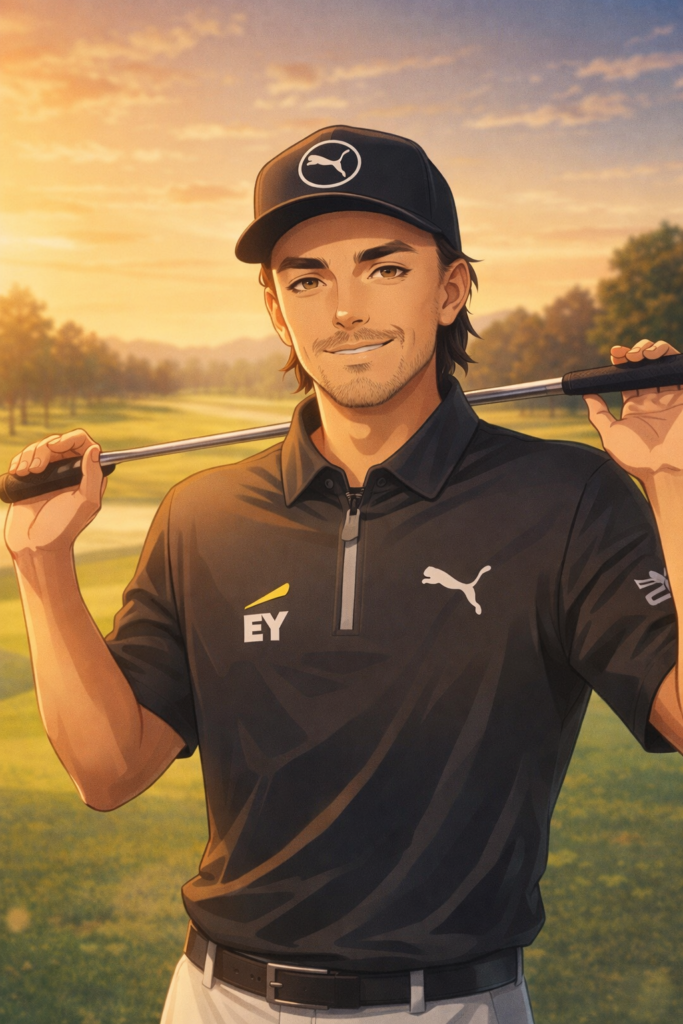
The 2015 Players Championship victory—golf’s unofficial “fifth major”—provided the answer to everyone who’d questioned whether he could deliver under maximum pressure.
But first, he had to survive what NBC’s Dan Hicks would call “the greatest finish I’ve ever seen in this championship.”
Sunday afternoon at TPC Sawgrass, trailing Sergio Garcia by five strokes with six holes to play. Five strokes. Six holes. The mathematics were brutal. Fowler needed Garcia to falter while simultaneously playing close to perfect golf—a combination that almost never happens at this level.
Standing on the 13th tee, Fowler made a decision that would define the next ninety minutes: stop trying to manage the situation and just attack.
The charge:
- Hole 13: Wedge to twelve feet, birdie putt never touched the sides
- Hole 15 (par-5): Another wedge, another birdie—deficit now three with three to play
- Hole 16 (par-5): Hybrid from 235 yards started at the water, drew back toward the flag, landed soft and checked thirty inches from the hole—eagle cut Garcia’s lead to one
- Hole 17 (island green): Nine-iron landed six feet past, spun back toward the cup—birdie putt fell center-cut, Fowler takes the outright lead
- Hole 18: Drive carried 331 yards, approach settled fifteen feet away—fifth consecutive birdie finds the hole
Six-under over six holes. The clubhouse lead at 12-under par.
In the scorer’s tent, signing his card, Fowler allowed himself to believe it might be enough. Then he looked at the television monitor and watched Garcia roll in a forty-three-foot bomb on 17 to tie him. Moments later, Kevin Kisner joined them at 12-under.
The greatest finish in Players Championship history wasn’t over—it was forcing the first three-hole aggregate playoff in tournament history.
The Playoff: Three Times at 17
The three-hole playoff began at 16 with pars. At 17, both Fowler and Kisner made birdie from inside ten feet, eliminating Garcia. Regulation 18th brought pars, forcing sudden death back to the island green.
For the third time in ninety minutes, Fowler stood on the 17th tee. His ball landed five feet away. Kisner’s putt from twelve feet slid past. Fowler’s—his third birdie at 17 that day—rolled in center-cut.
The celebration was immediate and unfiltered: fist pumps, roars, and a kiss with girlfriend Allison Stokke that became one of the most memorable images in Players Championship history.
This was the performance that critics said he couldn’t deliver—coming from five back with six to play, making clutch putts under maximum pressure, beating world-class players down the stretch when everything mattered most.
The anonymous player poll that had ranked him the most overrated player on tour earlier that year? This was his answer.
The Gospel of Becoming
When Becoming Is Sufficient
There exists in American mythology a particular form of cruelty: the demand that potential must be fulfilled, that promise must be kept, that becoming must eventually arrive at some final completed state where you can stop becoming and simply be.
Rickie Fowler’s career offers a different gospel: that becoming is sufficient, that the journey has value independent of destination, that you can spend your entire professional life in the space between promise and fulfillment and still have lived meaningfully, still have mattered, still have left the world better than you found it.
“Fowler’s sustained presence as someone who looked different while competing at elite levels—crucially, maintaining that through both peak and struggle—created permission for others to do the same.”
Fowler’s sustained presence as someone who looked different while competing at elite levels—crucially, maintaining that through both peak and struggle—created permission for others to do the same.
What Zac Efron’s Journey Reveals
The five Zac Efron films that have structured this analysis all converge on a single insight: that the highest achievement might be maintaining authenticity while everyone demands you become someone else.
The five lessons:
- Troy Bolton (High School Musical): Learned to integrate multiple identities despite a world insisting he choose one
- Mike O’Donnell (17 Again): Discovered that the life actually lived has value even when it disappoints expectations
- Cole Carter (We Are Your Friends): Learned that persistence doesn’t guarantee a payoff but maintains dignity
- Kevin Von Erich (The Iron Claw): Discovered that continuation itself becomes meaningful when you refuse to let tragedy define you
- Link Larkin (Hairspray): Learned that popularity discovers purpose when visibility serves change
Where the Story Stands Now
Fowler is 36 now, entering what might be the most productive years of his career—or what might prove to be a beautiful epilogue.
The 2023 comeback wasn’t an endpoint but a new beginning—proof that the work wasn’t wasted, that the wilderness taught rather than destroyed. Following his July 2023 victory, Fowler climbed back into the top 25 of the world rankings, but the path forward has proven challenging.
Current status (as of October 2025):
- World ranking: No. 77
- Age: 36
- Major championship window: Narrowing
- Swing fundamentals: Intact
- Confidence: Restored
At 36, the window for major championship contention grows narrower, though the athleticism and swing fundamentals that carried him through the wilderness years remain intact.
Whether the story has more championship chapters to write, or whether 2023 will stand as a beautiful epilogue to his competitive prime, only time will tell. But the confidence has returned—not as a temporary visitor but a permanent resident—and that alone makes whatever comes next worth watching.
Building in the Space Between
The question of nearness, it turns out, isn’t about distance to something you never quite reached. It’s about building a structure that can stand independently, that has integrity without external validation, that remains inhabitable even when the original blueprint suggested it was incomplete.
And now, perhaps most remarkably, it’s proving capable of expansion—of adding new rooms, new stories, new possibilities that seemed foreclosed just two years ago.
So what do you call someone who contended in all four majors in a single season without claiming any? Who tied the lowest round in U.S. Open history yet watched others lift the trophy? Who spent fifteen years as one of golf’s most recognizable figures while living perpetually in the space between promise and validation?
You call him Rickie Fowler—and you say it in the voice of someone who made room for joy.
What the Name Means
You call him Rickie Fowler. And everyone—from kids dressed in his colors to tour veterans to casual fans who don’t know a birdie from a bogey—knows exactly what that means.
It means someone who brought golf to people who needed it. It means someone who survived public struggle with private dignity. It means someone who discovered that the story everyone expected wasn’t the story worth living, and chose to live his actual story anyway.
“It means someone who proved that becoming doesn’t require arriving, that almost can be its own form of excellence, that the journey itself can be the destination if you walk it honestly enough.”
It means someone who proved that becoming doesn’t require arriving, that almost can be its own form of excellence, that the journey itself can be the destination if you walk it honestly enough.
And it means someone who demonstrated that even when the journey seems finished, it might just be finding new roads to travel. The marriage to Allison, the birth of Maya, the interests and passions beyond golf that provide ballast when golf itself proves insufficient—these aren’t distractions from his career but foundations that make his career sustainable.
Still Becoming
On practice ranges, he integrates competing demands into wholeness. His signature look remains, still recognizably his. The swing looks athletic and free, finally resembling the motion that once felt intuitive.
On Sundays, still wearing his distinctive style, still interacting warmly with galleries, still competing with the understated confidence that has always defined him, he appears at peace with exactly who he is while remaining hungry for what he might still achieve: not a tragic figure, not unfulfilled potential, not a cautionary tale about almost.
Just a golfer who refused to become anyone else to satisfy expectations, proving that the highest achievement might be remaining completely, unmistakably, sustainably yourself.
The question that defined his entire journey—whether proximity eventually becomes arrival, whether almost transforms into enough—remains beautifully, stubbornly unresolved.
He’s 36 now, his game restored, but time no longer infinite. The victories might accumulate or they might not. The major championship might come, or it might not.
None of it changes what he’s already accomplished: he made golf accessible to people who needed it, survived public struggle with private dignity, and proved that becoming doesn’t require arriving.
The Photo That Says Everything
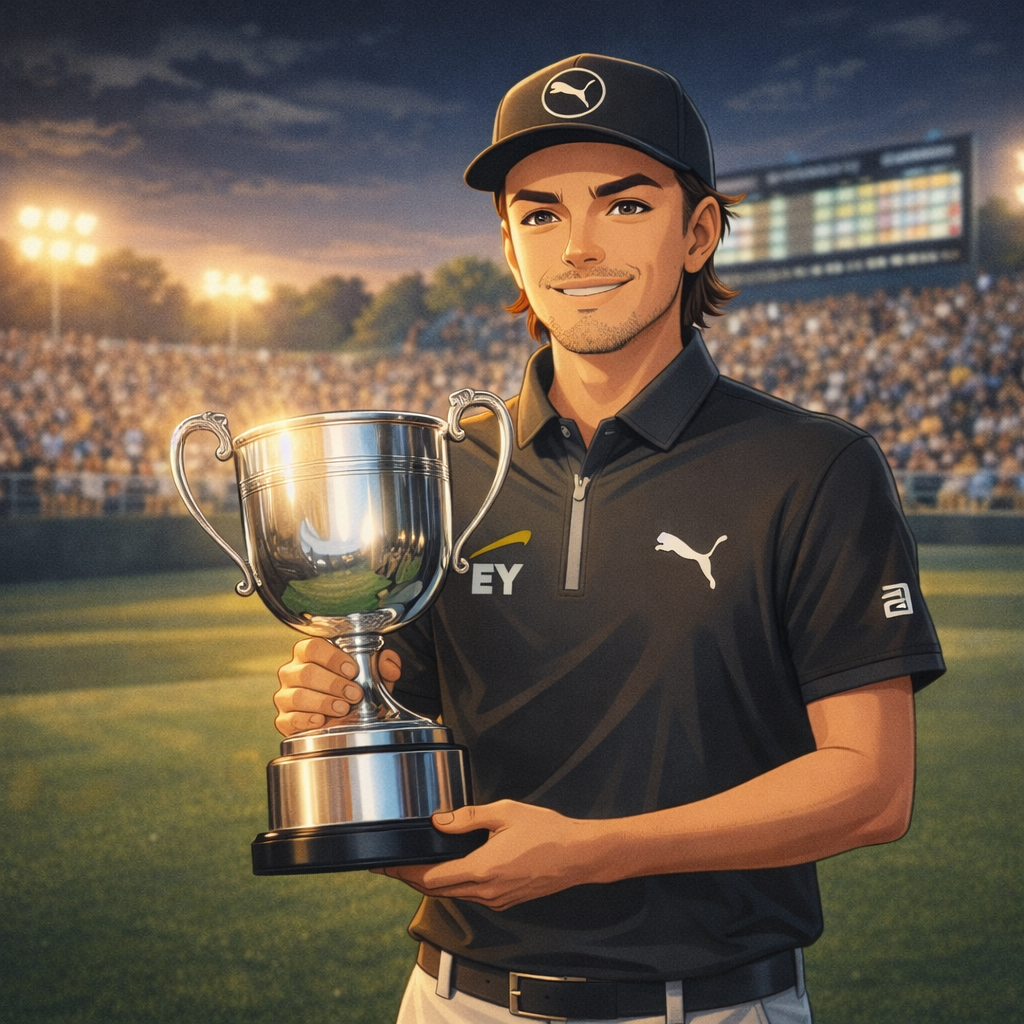
A photo from Detroit, July 2023: Fowler on the 18th green after the playoff victory, daughter Maya in his arms, trophy beside them.
She’s reaching for his face with both hands, completely uninterested in the trophy or the crowd or the cameras. And Fowler’s expression—pure joy, completely present, the look of someone who has finally figured out that the person holding him matters more than the hardware sitting three feet away.
Tomorrow he’ll tee it again, still searching, still becoming, still refusing to perform someone else’s version of completion. The orange. The flat brim. The stubborn patience. The quiet insistence that his story gets to remain his own, written in his own hand, finished or unfinished on his own terms.
That’s the point. That’s always been the point.